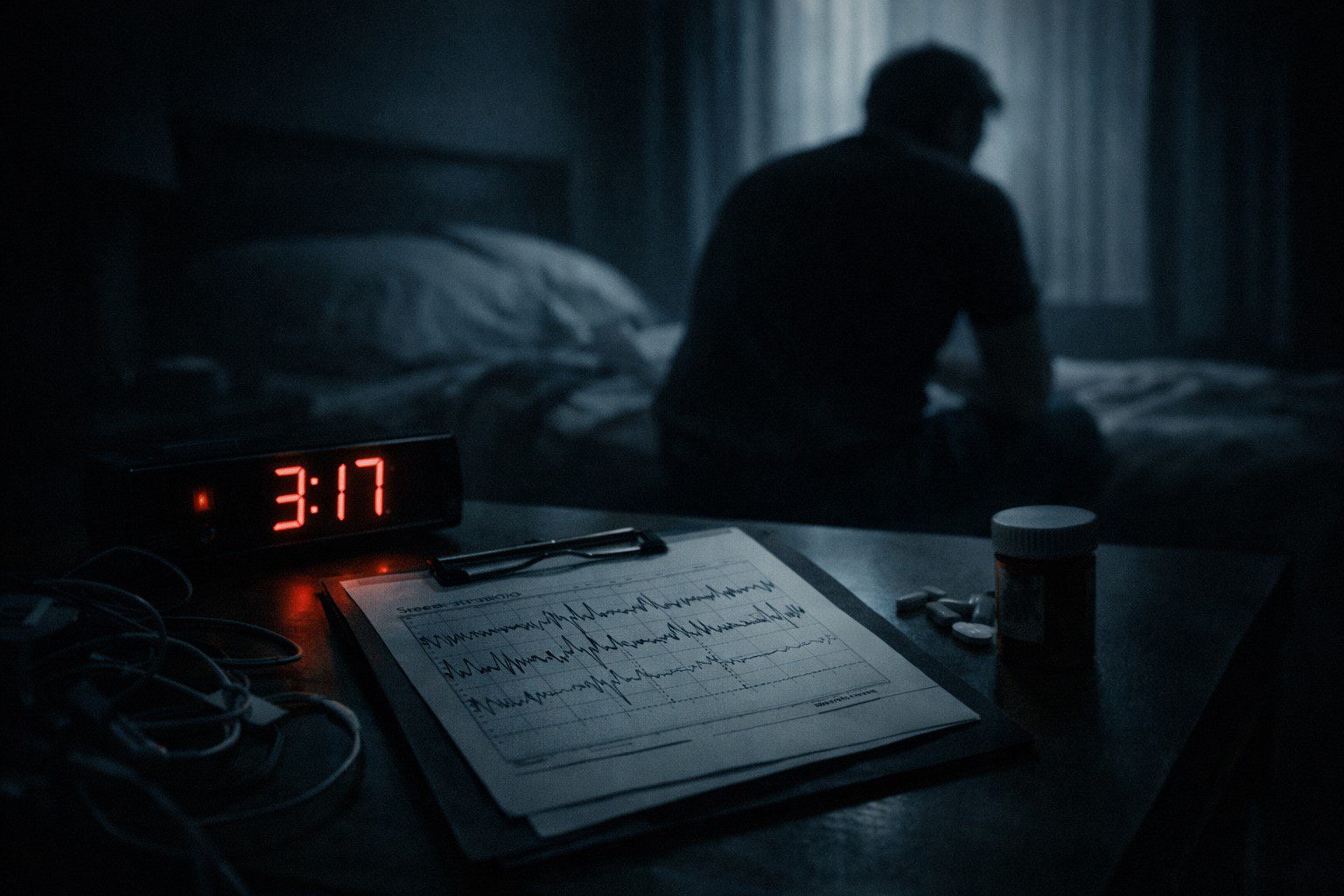
The sleep study showed I had been awake for nine days. My doctor delivered this information with the careful tone of someone managing a person they expected to become distressed. The distressing part, to me, was not the nine days. It was that I had no memory of any of them.
I had been living what I believed to be a normal life — working, eating, having conversations I could recall in detail. Not nine days of blackness. Nine days of ordinary, sequential, remembered experience that the sleep study’s electrodes said had happened while I was awake, sleep-deprived, and, according to the neurologist’s follow-up assessment, operating in a state of cognitive function that should not have been possible.
My name is Sol Vance. I was thirty-eight, I taught secondary school English, and I had enrolled in the sleep study because I had been feeling tired for several months. The kind of tired that built gradually and didn’t respond to weekends or rest or the usual remedies, the kind that made colleagues say you look a bit rough and then apologise for saying it. I had not thought I was not sleeping. I had thought I was simply not sleeping well.
The study ran for fourteen days. I wore sensors at home, pressed a button to indicate sleep and wake times, kept a log. I felt, during those fourteen days, that I went to sleep each night and woke each morning. My log said so. The sensors said otherwise.
Dr. Lena Farr had been my neurologist for forty minutes when she told me the results. She was precise and direct in the way of specialists who respected patients enough not to soften things into incomprehensibility.
“Your log shows fourteen sleep events across the study period,” she said. “The sensor data shows zero. You experienced no sleep during the fourteen-day monitoring window.”
“I felt like I was sleeping,” I said.
“I know. That’s what makes this unusual.” She placed a graph on the table between us — a flat, continuous line for fourteen days where an ordinary sleep record would have shown the peaks and valleys of sleep cycles. “You experienced something we call sleep state misperception — or at least, that’s the closest existing category. The brain convincing itself it has slept when it has not. But the extent and duration here is outside anything documented in the literature.”
“Fourteen days.”
“At minimum. You came to us after several months of tiredness. We can only measure what we measured.” She looked at me with the focused attention she had shown throughout. “I want to ask you some questions about the fourteen days you believed you were sleeping.”
She asked me to describe a night from the study period. I described it in detail: the time I got into bed, what I had read, when I had turned the light out, the particular quality of waking just before the alarm, slightly foggy, the way I always woke. She listened and typed and then showed me the sensor data for that night.
The sensors showed continuous wakefulness. At the time I said I had been reading, the light sensor confirmed the lamp was on. At the time I said I had turned the light off, the lamp had been on for two more hours. At the time I said I had woken before the alarm, the data showed I had been in continuous motion since two forty-seven a.m. — pacing, the movement sensor suggested, in a pattern consistent with the dimensions of my bedroom.
I had been pacing my bedroom for four hours in the early morning and had no memory of it.
I had turned the light off at three fifty-one a.m. I had believed I turned it off before midnight.

 WhatsApp
 Telegram
 Email







Leave a Reply