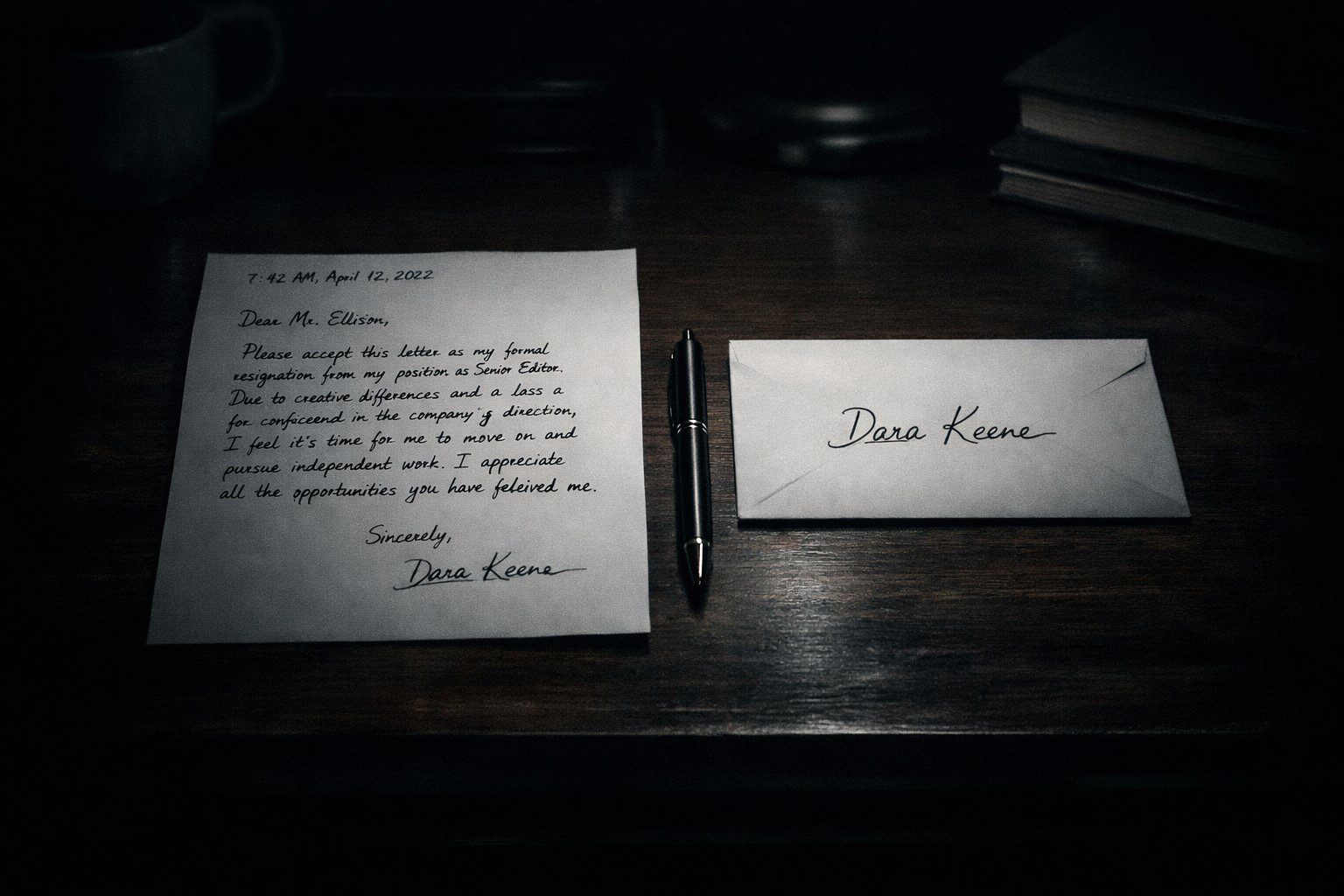
The resignation letter on my desk was in my handwriting. Every loop, every slant, every particular way I pressed the pen harder at the end of a word — mine, unmistakably. The problem was that I had not written it, and it was addressed to my editor, and it was dated that morning at seven forty-two, which was twenty minutes before I woke up.
I read it three times before I put it down. Then I picked up my pen and wrote my name on the back of an envelope. I held the two side by side for a long time.
Identical.
My name is Dara Keene. I was a senior editor at a mid-size publishing house — eight years in, the kind of position that took a decade to build and could be dismantled in an afternoon if the right letter reached the right desk. I lived alone in a flat on the fourth floor of a building on Calder Street, and I was, as far as I knew, a person who did not write letters in her sleep and had no reason to resign.
The letter was articulate and specific. It cited creative differences with the managing director, a loss of confidence in the company’s direction, and a desire to pursue independent work. These were things I thought privately and had never said aloud. Not to colleagues, not to friends, not in writing. They were the shape of thoughts I kept in the part of my mind I had not yet decided what to do with.
Whoever had written the letter knew exactly what those thoughts were.
I called my friend Marc, who was a GP and who I used as a first-line response when I needed someone to tell me whether I should be worried or not. He asked careful questions. Had I been under particular stress? Had I been sleeping normally? Had I experienced any periods of time I couldn’t account for? I said yes, yes, and no. He said to come in that day, which I did.
He checked me over, asked more questions, and referred me to a colleague for a more detailed assessment. He used the words dissociative episode in the way doctors used specific terms when they were trying to convey precision rather than alarm. He said it was uncommon but documented, that people sometimes performed complex tasks in altered states of consciousness with no subsequent memory, and that the letter — if I had written it — was consistent with a form of somatic expression of something I had not consciously processed.
I asked whether I should send the letter.
He said that was not a medical question.
I took the letter home and put it in a drawer and did not send it. Over the following week I paid unusual attention to my own behaviour — noting times, locations, what I had been doing, whether anything felt discontinuous. Nothing did. My days were ordinary. The letter sat in the drawer and did not multiply.
On the eighth day I found a second letter. This one was on the kitchen table when I came home from work, in the same handwriting, addressed to the man I had been seeing for four months — a careful, considerate man named Paul who I liked and who liked me and who I had been telling myself was exactly what I needed. The letter told him it was over. It gave reasons I had not allowed myself to articulate: that I was keeping him at a careful distance, that I was waiting for the relationship to feel safe before I let it matter, that I was tired of doing that and thought he deserved better.
I stood in the kitchen with the letter in my hands and felt the particular discomfort of reading something true about yourself that you had not given yourself permission to think.

 WhatsApp
 Telegram
 Email







Leave a Reply