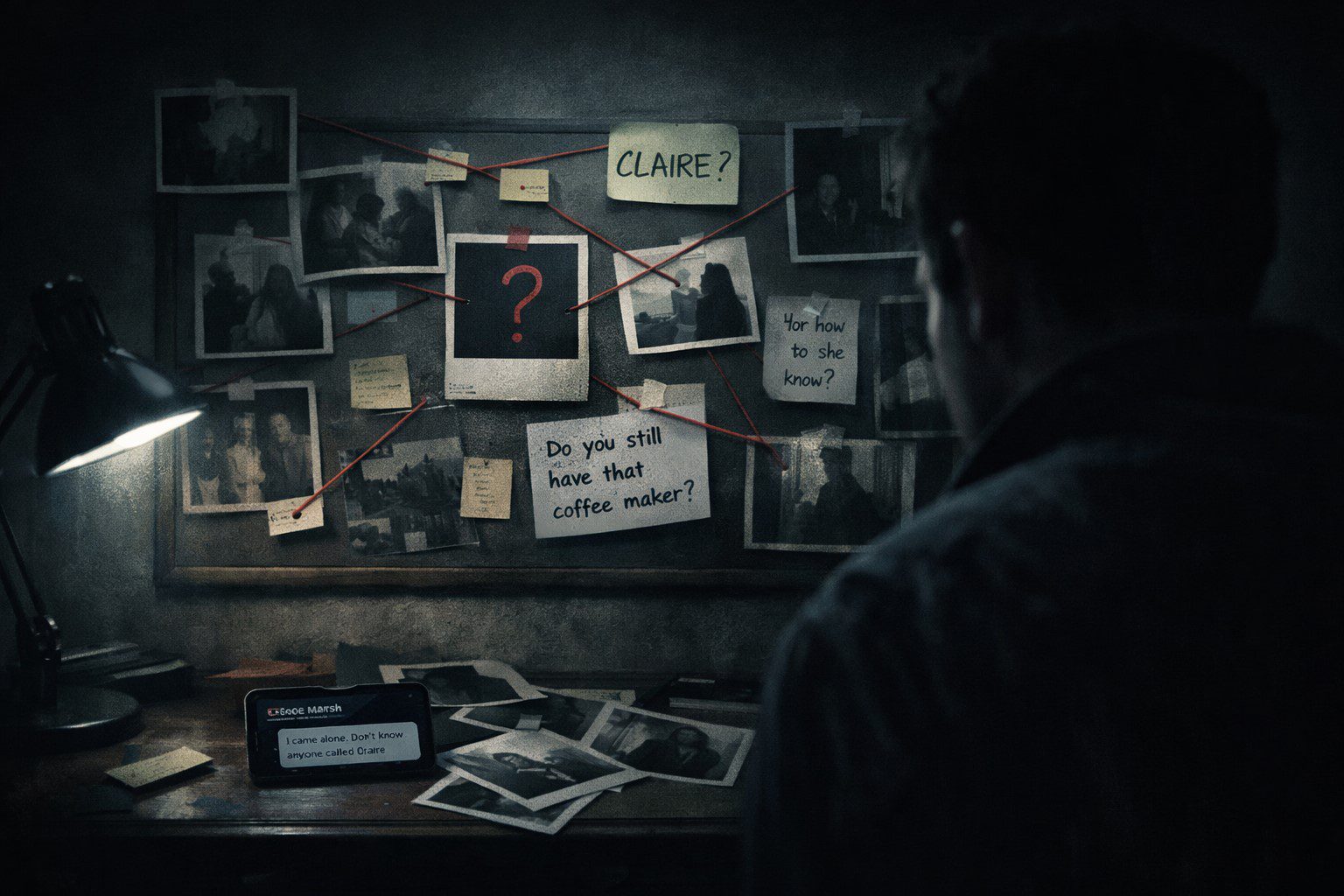
She called me by a nickname only my closest friends used, and she knew the name of my childhood dog, and she laughed at the right moments in a story I told her about university as though she had heard it before. When I got home I searched every photograph I owned from the last twenty years and found no trace of her face.
Her name, she had told me at the dinner party, was Claire.
My name is Leo Marsh. I was thirty-seven, I worked in urban planning, and I had a social life that was busy enough to make it plausible, on the surface, that I might have forgotten someone. People moved in and out of circles. Introductions were made and not retained. Names slipped. I was not unusual in this.
But Claire had not behaved like someone I had just met. She had behaved like someone reestablishing contact. She had asked about my sister by name. She had said, at one point, do you still have that terrible coffee maker in the tone of someone referencing a shared memory, and I had laughed and said yes because I did, in fact, still have it, and only later, in the taxi home, had I thought: I have not told anyone about that coffee maker. It was a running joke with myself. It was not something I shared.
I had asked the host, Petra, how she knew Claire. Petra had looked briefly puzzled and said she didn’t — that Claire had come with Marcus, Petra’s colleague. I had texted Marcus that night. He replied the following morning: Don’t know anyone called Claire. I came alone.
I went back through my phone. My contact list, my messages, my email, my social media. I searched the name Claire across all of it. I found three Claires: a work contact I had emailed once about a planning consultation, a university acquaintance I hadn’t spoken to in eleven years, and my mother’s dentist. None of them were the woman at the dinner party. The faces didn’t match and the context didn’t fit.
I described her to Petra. Medium height, early forties, dark coat, dark hair cut just below the jaw, a slight accent I hadn’t been able to place. Petra listened carefully and said she had a vague memory of the woman but couldn’t have named her — she had assumed she was with someone else’s group, not Marcus’s.
A woman had been at a dinner party of twelve people, spoken to most of them, stayed for three hours, and left no verifiable trace of how she had been invited or who had brought her. That was odd. That was very odd. But the oddness that kept returning to me, the detail I couldn’t set down, was the coffee maker.
I called my sister Anya on the Friday. I told her what had happened, in the matter-of-fact way I told Anya things, because she was the person in my life most likely to find a practical explanation without making me feel strange for looking. She listened all the way through and then asked one question.
“The nickname,” she said. “The one Claire used. Did you tell me what it was?”
I had been about to. Then I stopped.
The nickname was Lemon. It had been given to me when I was nine by a group of friends at primary school, a name connected to a specific incident involving a lemon drizzle cake at a school fair that I had not thought about in years. I had not been called it since secondary school. I had not spoken about it to anyone in my adult life. I had no memory of mentioning it to anyone at the party, or to anyone in recent years.
“She called me Lemon,” I told Anya.
A pause. “No one calls you that.”
“No.”

 WhatsApp
 Telegram
 Email







Leave a Reply