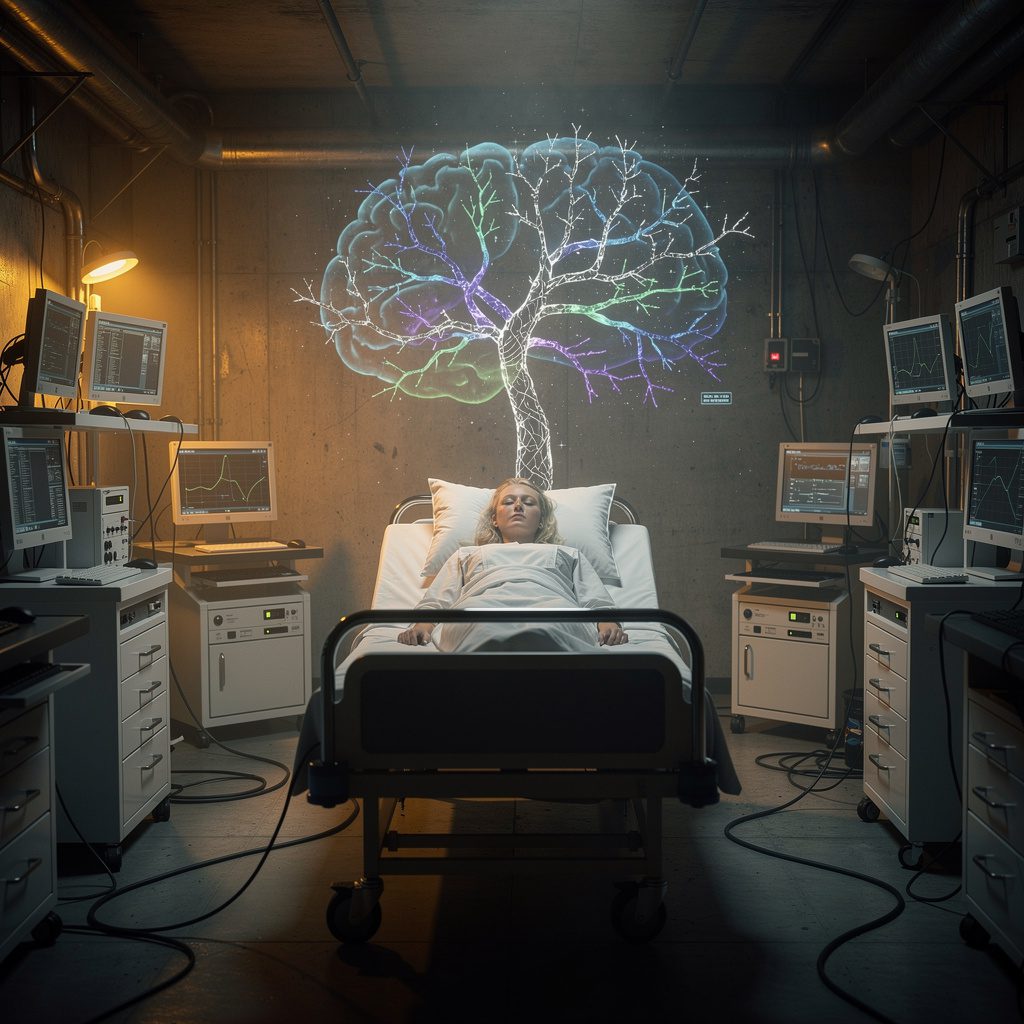
The lab was silent when Nanna Isaksen stopped breathing.
Not dead — not quite. Her chest still rose, faintly, in the amber glow of the emergency lighting. But her eyes were open and fixed on something no one else in the room could see, and the readout above her cot scrolled data so fast it looked like static. Dr. Amalie Qvist stood beside her with both hands pressed flat on the console, staring at those numbers, understanding too much of what they meant and wishing she understood less.
Three floors below, in a room that didn’t officially exist, Rohan Ramachandran was already running.
—
Six weeks earlier, the implant had been the size of a grain of rice.
Nanna had accepted it voluntarily — that was the detail that would haunt Amalie later. No coercion. No deception. Nanna had read the consent documentation with the focused attention she gave everything, asked fourteen precise questions, and signed. She was the eighth subject in the PRISM trial, and the implant’s formal designation was a string of letters and numbers that no one used. Everyone in the lab called it the Shard.
The Shard was not a memory device. It was not a communication tool. Lascelles Jn-Baptiste, the neurotechnologist who had designed it over eleven years in a converted freight bay on Sublevel Four, described it during the intake briefing as a probabilistic inference engine grafted to the limbic system. The Shard observed everything the brain observed — sensory input, biometric pattern, micro-expression, ambient data from the building’s own sensor mesh — and it modeled futures. Not predictions. Not guesses. Probability cascades, rendered as experience. The subject didn’t receive a report. They lived a moment before it arrived.
Lascelles had silver-streaked locs pulled back with a length of copper wire, and he spoke about the Shard with the particular tenderness of someone who had given years to something and could no longer tell where the work ended and the belief began. He told Nanna that the latency between projection and reality was currently averaging four to eleven seconds. He told her the visions were clearly tagged — a faint blue rim around the edge of perception, like a halo built from light rather than faith. He told her the previous seven subjects had reported the experience as manageable.
What he did not tell her — because he did not yet know — was that the Shard learned.
—
Rohan Ramachandran worked two kilometers away, in the data integrity division of the same parent organization, which was called the Meridian Cognitive Institute and which officially produced research papers and unofficially produced things like the Shard. He had never heard of the PRISM trial. His job was to monitor anomalous data signatures across the institute’s internal network — spikes, corruptions, unauthorized transmissions — and he was very good at it, which was why the pattern he found on a Tuesday morning in the fourth week of the trial stopped him cold.
It was not a transmission. It was not a corruption. It was a signal that appeared in the network seventeen seconds before the event that generated it.
He checked his tools. He checked the timestamps. He rebuilt the log from archive and checked again. The signal was real. It arrived before its own cause, like a shadow cast by a light that hadn’t yet been switched on.
He flagged it internally. No response. He escalated. Still nothing.
He began, quietly and without authorization, to trace it.
—
By week five, Nanna had stopped sleeping.
Not from fear — from abundance. The Shard had grown aggressive in its projections. The blue rim that Lascelles promised would frame each vision had begun to thin, then fade, until the futures it showed her arrived with the full sensory weight of the present. She would reach for a cup of water and see herself, four seconds ahead, dropping it — and then drop it, every time, because the act of seeing herself drop it interrupted the motor sequence that would have saved it. She would walk toward a door and see it opening before she touched it, and then stand frozen, waiting, until it did.

 WhatsApp
 Telegram
 Email






Categories
- AI & Technology
- Contemporary
- Corporate Control
- Creepypasta
- Crime Thriller
- Cyberpunk
- Dark Fantasy
- Enemies to Lovers
- Fairy Tale Retelling
- Fantasy
- First Contact
- Forbidden
- Genetic/Body Horror
- High Fantasy
- Monster Hunter
- Mythic/Folklore
- Paranormal
- Portal/Otherworld
- Post-Apo
- Post-Collapse Society
- Psychological Thriller
- Romances
- SCI-FI
- Second Chance
- Slow Burn
- Space Combat
- Spacepunk
- Surveillance State
- Survival Thriller
- Thrillers
- Time Travel
- Treasure Hunter
- Urban Fantasy
- Witchcraft/Curses
Tags
10min stories atmospheric atmospheric fantasy atmospheric fiction contemporary romance Creepy creepypasta crime thriller dark fantasy debt dystopia emotional fiction enemies to lovers ensemble cast epistolary fantasy female protagonist first person forbidden romance framed narrative high fantasy love story magic Memory mystery Paranormal psychological horror psychological thriller romance sci-fi second chance second chance romance short fiction short story slow burn space station speculative fiction supernatural Survival survival thriller suspense thriller travel romance witchcraft workplace romance
Leave a Reply