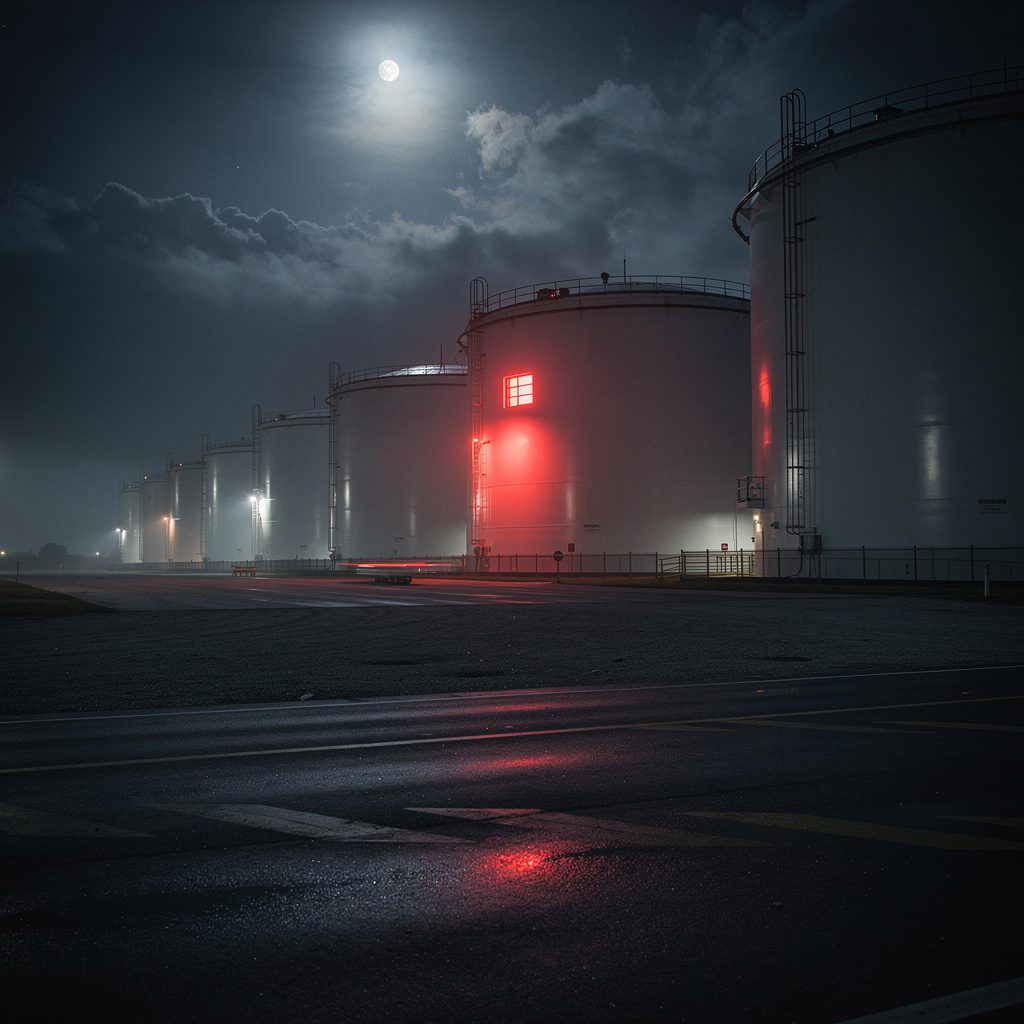
The compressor had been running for eleven hours straight when Tiago Cunha first noticed the terminal.
It sat at the far end of the auxiliary control room — a room that, according to the depot’s floor schematics, was used exclusively for pressure monitoring and valve override. Tiago had worked the night shift at the Galveston fuel storage facility for six years. He knew every panel, every gauge, every cabinet that groaned in the Gulf Coast humidity. He did not know this terminal.
The screen was already on.
It showed a simple grid — eight squares arranged like a board, some dark, some lit pale green. At the top, in block letters: ROUND 1 OF 6. Below that, a single line of text that Tiago read twice before he believed it: CHOOSE A SQUARE. EACH ROUND, THE STAKES INCREASE. FORFEIT AND THE GAME ENDS FOR EVERYONE ON SITE.
He pulled his radio from his belt. Static. Then more static. He moved to the window — three floors above the tank farm, where row after row of white cylindrical tanks stretched toward the waterline — and the radio gave him nothing but a low, continuous hiss.
He should have walked away. He knew that. He had worked enough night shifts in enough industrial facilities to understand that unattended equipment displaying unsolicited prompts was a safety incident, not a curiosity. You document, you radio, you evacuate if necessary. You do not interact.
But the terminal was already counting down. A red number in the corner: 90. Then 89.
Tiago pressed the square in the upper left corner.
—
Anders Hagen had been watching him for forty minutes.
He sat in a modified service van parked against the perimeter fence on the facility’s eastern edge, a laptop open on the passenger seat, a thermal flask of coffee cooling beside it. The footage from the auxiliary control room’s internal camera was crisp. He could see every detail — the way Cunha’s jaw tightened when he read the screen, the slight hesitation before the keypress, the exhale after.
Anders had run this sequence before. Different facilities, different workers. A chemical plant outside Baton Rouge. A water treatment station in Gary, Indiana. A grain elevator in Manitoba that nobody ever wrote about because the outcome had been, by his standards, unremarkable.
He was not sadistic. He wanted to be clear about that, at least to himself. He was a systems analyst. He had spent fifteen years studying how people behaved under institutional pressure — how they weighed personal risk against collective threat, how they made decisions when the information was incomplete and the clock was running. No university would fund what he needed to know. No ethics board would approve the study design. So he had built the study himself.
The terminal was his. The radio jamming was his. The two technicians who were supposed to be on shift with Cunha tonight had each received — through very different and untraceable channels — reasons to stay home.
Anders watched Cunha press the square and noted the timestamp.
—
Round two.
The chosen square had turned red. The board had shifted — new configuration, three squares lit, five dark — and the stakes line now read: PRESSURE RELEASE ON TANK ROW C HAS BEEN DISABLED. CHOOSE CORRECTLY AND IT RESTORES. CHOOSE WRONG AND THE TIMER RUNS.
Tiago stepped back from the terminal.
Tank Row C held three of the facility’s largest propane reserves. He had done the safety briefings. He knew what a sustained pressure buildup in an unvented tank looked like at the end of its arc. He also knew that the screen could be lying. Whoever had installed this thing — and someone had installed it, walked it in through a maintenance door, bolted it to the floor — could have written anything on it. Could have fabricated a threat that didn’t exist.
He pulled out his phone. No signal. He tried the landline on the wall panel: dead.
The countdown read 71.
He chose.
—
Anders watched the choice register and made a notation.
Subject does not attempt physical investigation of tank row before choosing. Accepts terminal’s authority without verification. This was the part that always struck him — not the fear, but the surrender of epistemic agency. They stopped asking whether the screen was telling the truth and started asking only which square was correct. The terminal became the authority. The terminal became the only real thing in the room.

 WhatsApp
 Telegram
 Email







Categories
- AI & Technology
- Contemporary
- Corporate Control
- Creepypasta
- Crime Thriller
- Cyberpunk
- Dark Fantasy
- Enemies to Lovers
- Fairy Tale Retelling
- Fantasy
- First Contact
- Forbidden
- Genetic/Body Horror
- High Fantasy
- Monster Hunter
- Mythic/Folklore
- Paranormal
- Portal/Otherworld
- Post-Apo
- Post-Collapse Society
- Psychological Thriller
- Romances
- SCI-FI
- Second Chance
- Slow Burn
- Space Combat
- Spacepunk
- Surveillance State
- Survival Thriller
- Thrillers
- Time Travel
- Treasure Hunter
- Urban Fantasy
- Witchcraft/Curses
Tags
10min stories atmospheric atmospheric fantasy atmospheric fiction contemporary romance Creepy creepypasta crime thriller dark fantasy debt dystopia emotional fiction enemies to lovers ensemble cast epistolary fantasy female protagonist first person forbidden romance framed narrative high fantasy love story magic Memory mystery Paranormal psychological horror psychological thriller romance sci-fi second chance second chance romance short fiction short story slow burn space station speculative fiction supernatural Survival survival thriller suspense thriller travel romance witchcraft workplace romance
Leave a Reply