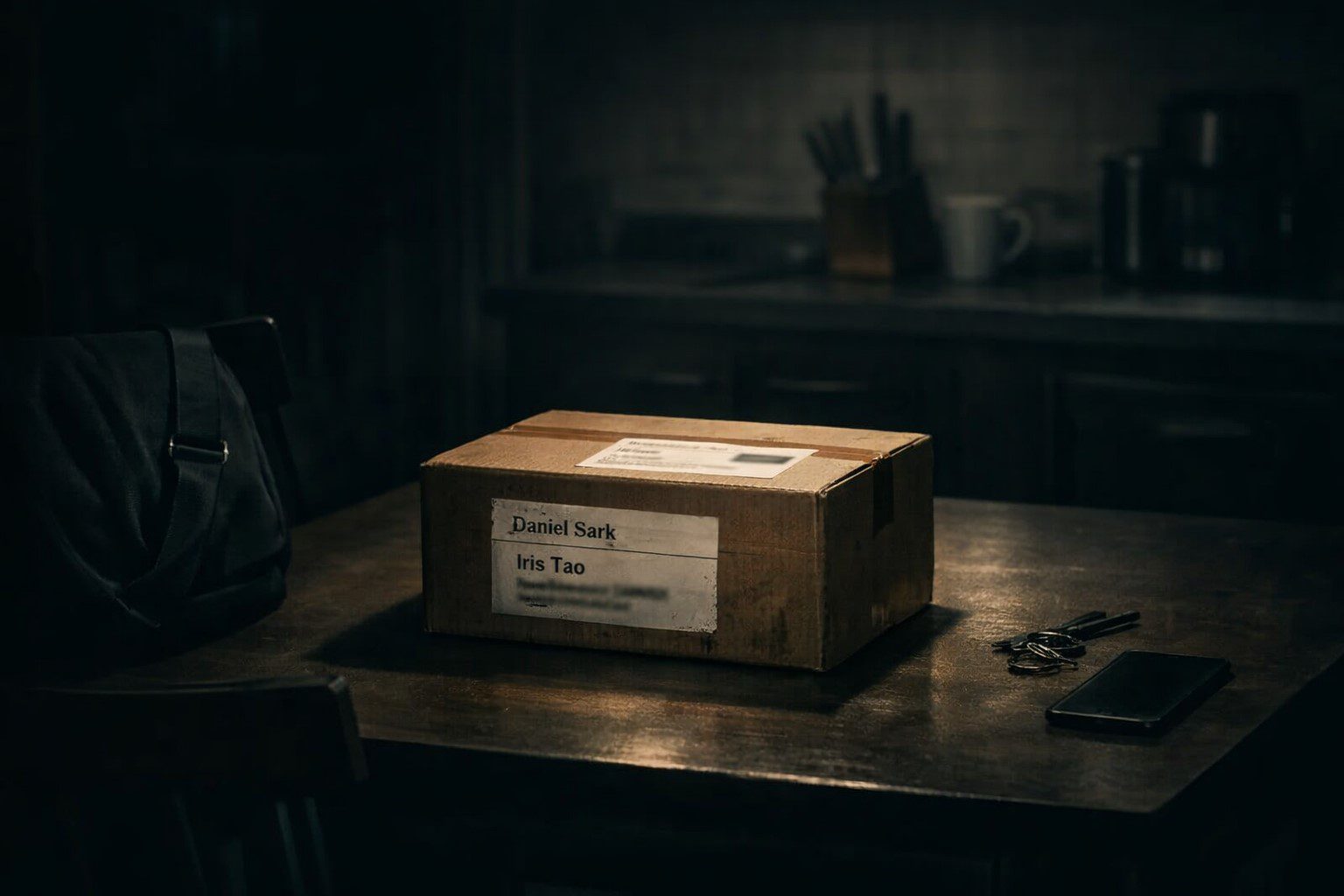
It arrived on a Tuesday with my name on it, my address on it, and a return label belonging to a man who had been reported missing in the city three weeks earlier. I set it on the kitchen table and stood there looking at it for a long time before I understood that I needed to make a decision before I made a phone call.
The package was the size of a shoebox. It was not ticking. It felt light when I had lifted it from the doorstep. These were the details I catalogued while I stood in my kitchen in my coat and my work bag still on my shoulder, because cataloguing details was what I did for a living and old habits were hard to break.
My name is Iris Tao. I was an insurance fraud investigator for eleven years, which meant I had spent more than a decade being professionally suspicious of things that looked ordinary. A package on a doorstep looked ordinary. My name on the label looked ordinary. What did not look ordinary was the name on the return address — Daniel Sark — which I had seen on the missing persons notice posted in the lobby of my building six weeks earlier, and in three follow-up articles in the local news since.
Daniel Sark had lived two floors above me. We had nodded at each other in the lift. I knew his face and his first name and the fact that he owned a grey bicycle he kept in the bike store by the entrance. I did not know him well enough to expect a package from him. I did not know him at all well enough to expect one after he had been missing for three weeks.
I put my bag down. I did not open the package. I sat at the table across from it and thought.
The honest version of events was this: Daniel Sark was missing, and something he had sent — or something someone had sent using his name and return address — had arrived at my flat. The sensible next step was to call the police, hand over the package, and let the people whose job it was handle it.
But I was an investigator, and there was a version of this that the police would handle by taking the package away and telling me nothing and closing a door I had not yet had a chance to look through. I had spent eleven years looking through doors that other people preferred closed. The instinct was not easy to turn off.
I examined the outside of the package carefully, without touching the label again. The handwriting was neat, controlled, printed rather than cursive — the kind of writing that gave nothing away. The postmark was from a sorting office on the east side of the city, dated four days ago. Four days ago, Daniel Sark had already been missing for two and a half weeks.
Someone had sent this after he disappeared. Using his name and address.
Which meant either Daniel Sark had sent it himself before vanishing and it had been delayed in the postal system, or someone else had sent it and wanted the return address to be his. Either option was worth understanding before I handed it to anyone.
I opened the package.
Inside, wrapped in a single layer of brown paper, was a notebook. Small, hardcover, the kind you found in stationery shops — dark green cover, no markings on the outside. I opened it with a pen, not my fingers, pushing the cover back the way I had learned years ago when handling documents that might matter later.

 WhatsApp
 Telegram
 Email







Leave a Reply