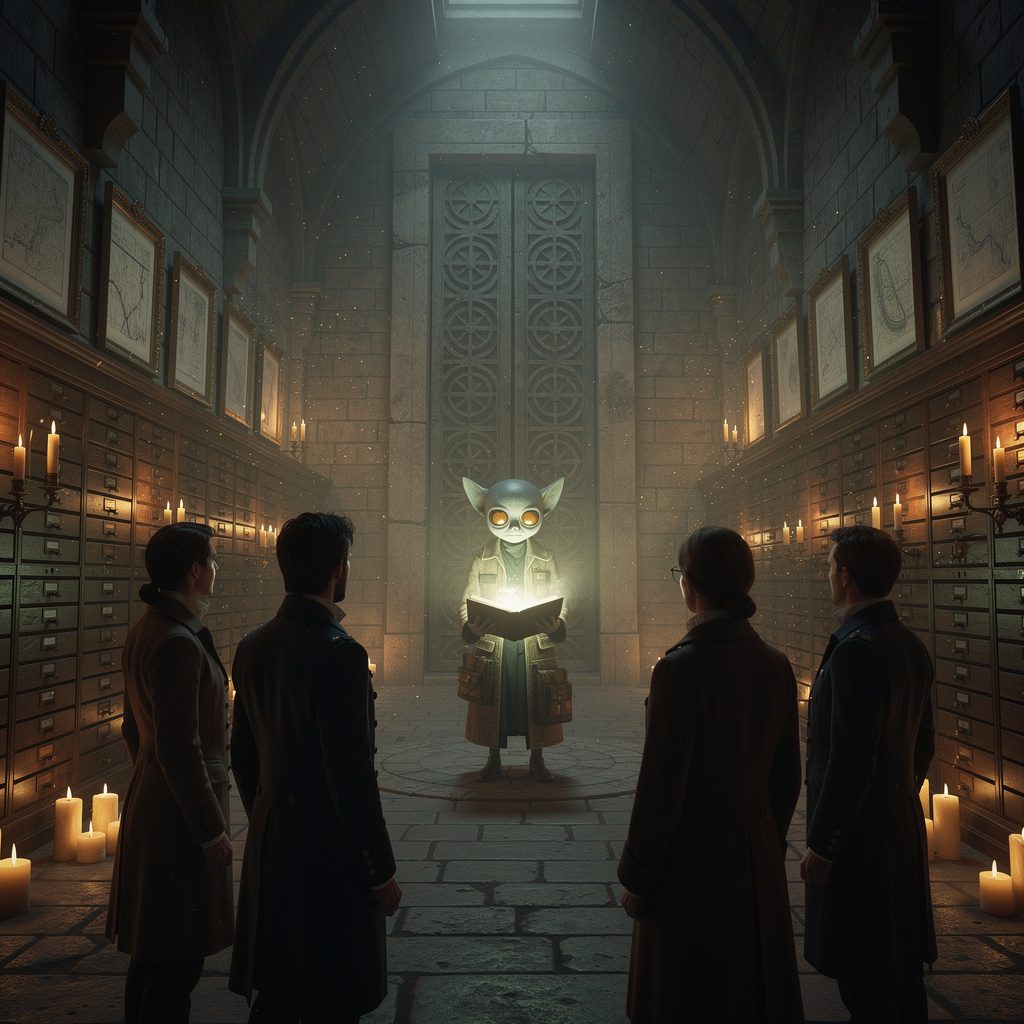
The archivist’s hall of the Carrington Institute had not changed in forty years. That was, in fact, its primary virtue. Miriam Carrington had said so herself on the morning in question, pouring her third cup of black tea at the long oak table while Rocio Alvarez spread survey charts across the far end and Sven Aasen stood at the window watching the courtyard fog settle between the cobblestones like a tenant who had forgotten to pay rent. The hall was a deep, amber-lit room on the ground floor of a four-story building that smelled of old paper, linseed oil, and the particular dusty authority of institutions that have outlasted every government that once funded them. The walls were lined with map drawers — flat, wide, labeled in faded ink — and above them hung framed survey prints of coastlines that no longer matched their shores. A brass chandelier held twelve candles, of which seven were lit. The flagstone floor was uneven in two places where tree roots had pushed up from below, and a crack ran diagonally across the northeast corner where the building had settled during a long-ago winter. Miriam had catalogued that crack. She had catalogued most things in this room. She was sixty-one, compact and deliberate, with silver hair cut close to her head and hands that had handled so many old documents they had taken on a papery quality themselves, as if she might, given enough time, become an artifact. She wore her reading glasses on a chain and her authority the same way — close, always accessible, never ostentatious.
The watcher had been in place since before they arrived.
No one in the hall knew this. The watcher occupied a narrow space behind the eastern map drawers, in a gap between the wall and the freestanding shelving unit that had been installed two decades ago with a six-inch miscalculation that no one had ever corrected. It was a good gap. The watcher had used worse. From there, the full length of the hall was visible, and the door at the far end — the north door, the one that led to the stairwell — was perfectly framed.
Except that door had not been there yesterday.
Rocio saw it first, though she did not say so immediately. She was twenty-eight, with dark eyes that moved fast and a habit of cataloguing exits before she catalogued anything else, a habit she had developed in fieldwork and never quite shed indoors. She had been reaching for a pencil when her hand stopped mid-air and her gaze went to the north wall. She looked at it for three full seconds. Then she picked up her pencil and drew a line on the survey chart as if nothing had happened.
“Miriam,” she said quietly. “When did the north door go in?”
Miriam looked up from her ledger. “What north door?”
Sven turned from the window.
The door was set into the stone as if it had always been there. That was the most unsettling thing about it — not its presence but its confidence. It was a tall door, narrower than standard, framed in dark wood that had been carved with a repeating pattern of interlocking circles, each one slightly different from the last, as if the carver had been trying to work something out and never quite reached the answer. The wood itself was wrong for the building — too dark, too dense, with a grain that ran in two directions simultaneously in a way that made the eye slide off it. The handle was iron, shaped like a closed fist, and it was warm. Rocio had touched it without meaning to, her fingers brushing the knuckles of the iron fist, and she had pulled her hand back with the specific expression of someone who has accidentally touched something alive.
“Don’t,” said Sven.
“I already did.”
Miriam was standing in front of it now. She had her glasses on. She was reading the carved circles the way she read documents — methodically, left to right, top to bottom — and her face had gone very still in the way it went still when she had already made a decision and was only gathering evidence to confirm it.
“It’s a transit door,” she said.
“A what?” Sven asked.
“The Institute’s founding charter mentions them. I thought it was metaphorical.” She touched the carved frame, not the handle. “Apparently not.”
Behind the shelving unit, the watcher went very still.

 WhatsApp
 Telegram
 Email







Categories
- AI & Technology
- Contemporary
- Corporate Control
- Creepypasta
- Crime Thriller
- Cyberpunk
- Dark Fantasy
- Enemies to Lovers
- Fairy Tale Retelling
- Fantasy
- First Contact
- Forbidden
- Genetic/Body Horror
- High Fantasy
- Monster Hunter
- Mythic/Folklore
- Paranormal
- Portal/Otherworld
- Post-Apo
- Post-Collapse Society
- Psychological Thriller
- Romances
- SCI-FI
- Second Chance
- Slow Burn
- Space Combat
- Spacepunk
- Surveillance State
- Survival Thriller
- Thrillers
- Time Travel
- Treasure Hunter
- Urban Fantasy
- Witchcraft/Curses
Tags
10min stories atmospheric atmospheric fantasy atmospheric fiction contemporary romance Creepy creepypasta crime thriller dark fantasy debt dystopia emotional fiction enemies to lovers ensemble cast epistolary fantasy first person forbidden romance found text framed narrative high fantasy love story magic Memory mystery Paranormal psychological horror psychological thriller romance sci-fi second chance second chance romance short fiction short story slow burn space station speculative fiction supernatural Survival survival thriller suspense thriller travel romance witchcraft workplace romance
Leave a Reply