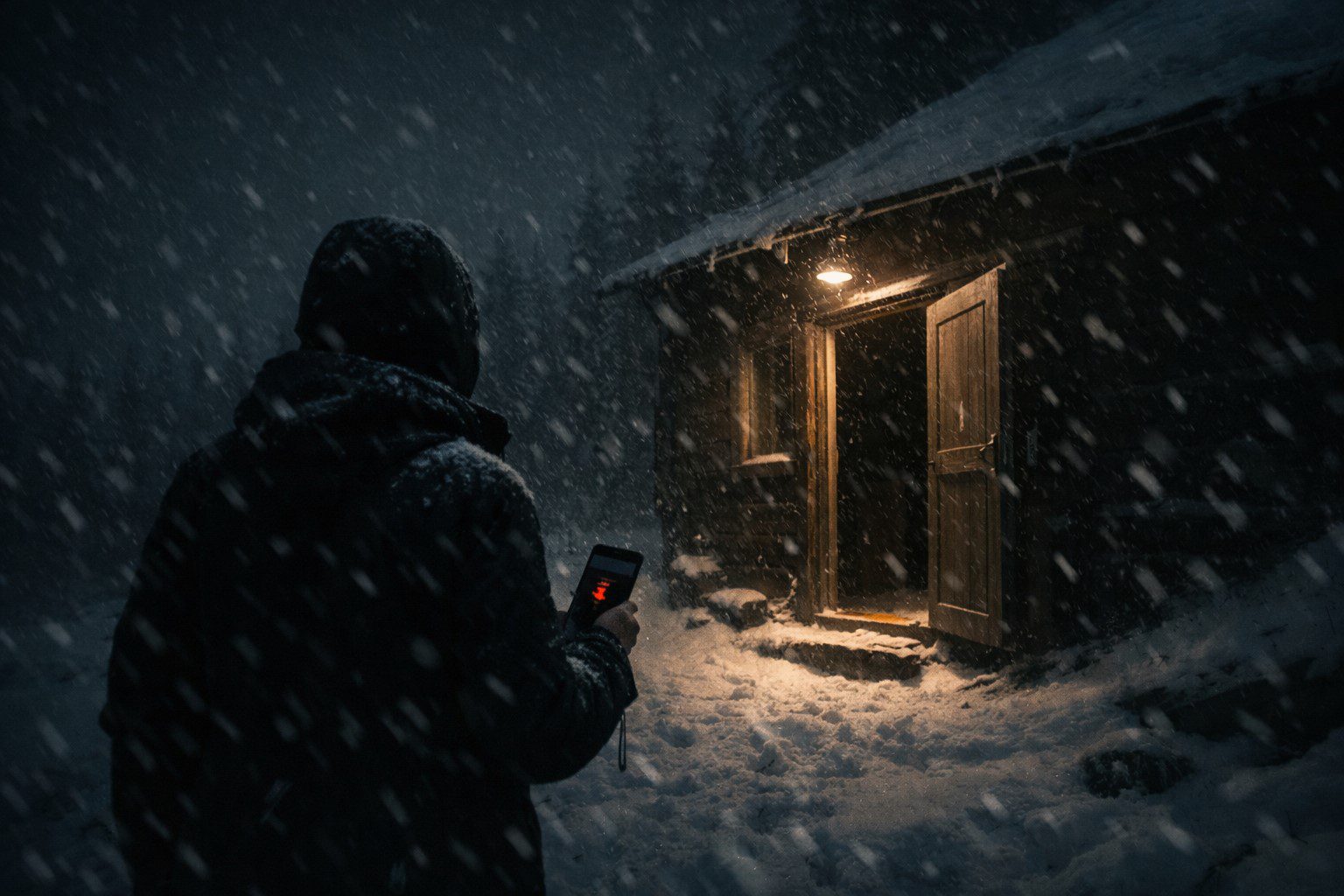
The weather app showed clear skies when I drove into the mountains. By the time I reached the cabin, the snow was coming down so hard I could barely see the treeline — and my phone had no signal, no map, and a battery at eleven percent.
I was alone. And the cabin door was already open.
My name is Petra Vasic. I was a structural engineer, which meant I spent my professional life calculating what things could withstand before they gave way. I was good at it. I was precise and systematic and I did not panic under pressure — I had always counted that among my more useful qualities. I had taken this long weekend in the mountains because I had spent three months on a project that nearly broke me, and I needed forty-eight hours of silence and cold air and absolutely nothing to solve.
I had not anticipated having to solve anything at the level of staying alive.
The cabin belonged to a colleague, Miro, who had lent it to me with a hand-drawn map and a key on a red fob and the assurance that it was fully stocked and that the wood stove was straightforward. He had not mentioned that the door would be standing open in what was now, by any measure, a serious mountain storm. I pushed it fully open with one hand, my bag in the other, and stood on the threshold and looked in.
The cabin was a single large room. A kitchen counter along one wall, a table and two chairs, a sofa, the wood stove in the corner with a neat stack of logs beside it. A door to what I assumed was the bathroom. Everything in order, nothing disturbed. No sign of how the door had come open, no damage to the frame or lock. Just the door, standing wide, and the cold coming through it, and the snow already beginning to dust the threshold boards.
I stepped inside and pulled the door shut behind me and stood with my back against it for a moment, listening.
Nothing. Only the wind.
My first priority was heat. The wood stove was, as Miro had promised, straightforward — and within twenty minutes I had a fire going and the chill was beginning to ease from the room. My second priority was my phone. I found a cable and a wall socket and plugged it in and watched the charging icon appear with the particular relief of someone who has just secured a lifeline.
Then I tried the signal again. Still nothing. The storm had closed in completely now — I could hear it against the roof, a low and constant pressure, the kind of sound that makes you aware of how much weather there is and how little stands between you and it. Through the window the world was white and moving and entirely without landmark. The treeline had vanished. I could see perhaps three metres past the glass.
I made tea, I found bread and cheese in the kitchen, and I sat at the table and told myself this was manageable. I was in a solid structure. I had heat, food, water, a charging phone. The storm would pass. Miro knew I was here. If I wasn’t back by Monday he would call someone.
I had been sitting there for perhaps an hour when I heard the sound on the roof.
It was not the wind. I had been listening to the wind for an hour and I knew its texture — continuous, directional, with a low note underneath the higher surface noise. This was different. Rhythmic. Deliberate. Three sounds in sequence, a pause, then three again. Evenly spaced, like someone walking.

 WhatsApp
 Telegram
 Email







Leave a Reply