I have been keeping this record for reasons that will become clear. Perhaps they already are, if you know where to look. I am writing from a room that smells of dried fennel and copper, with a window that faces a courtyard I cannot leave. But I am getting ahead of myself. Let me begin where all things begin — with two people who did not yet know they were walking toward each other.
The first was Adaeze Asante, a hunter of the kind that most cities pretend do not exist.
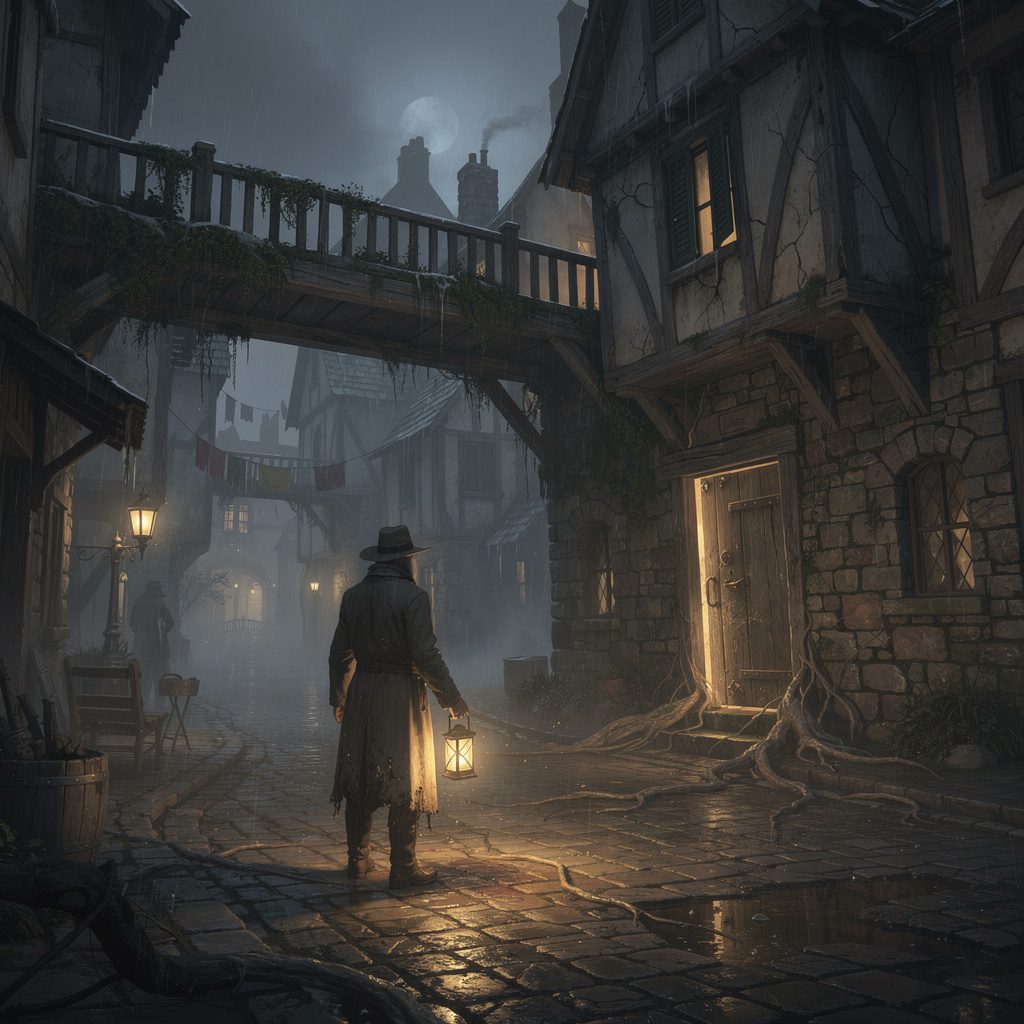
The Hollow Ward of Vethmarr was a district built at the edge of a canal that no longer carried water, only a slow, dark residue that caught lamplight and held it like a bruise. The buildings here leaned inward over narrow lanes as though whispering to one another, their upper stories connected by wooden bridges draped in damp moss. The cobblestones were old enough to have worn smooth on one side and cracked on the other, and the cracks were filled with the pale root-threads of something that had been growing there long before the city was built around it. Adaeze knew this ward the way she knew her own hands — every alley, every dead-end courtyard, every cellar door that should not be opened after the third bell. She had been hunting in Vethmarr for eleven years. She wore a long coat the color of river clay, lined inside with dozens of small pockets, each one holding something specific: a vial of oil pressed from the seeds of the ghost-nettle plant, a folded slip of bark inscribed with a binding word, a coil of copper wire threaded with dried heather, a small clay jar sealed with wax the color of old bone. Her face was broad and deliberate, her dark eyes trained to notice the wrong things — the shadow that bent the wrong way, the smell of iron where there should be none, the sound of breathing behind a wall that had no room behind it. She moved without hurry. Hunters who hurried made mistakes. Mistakes in the Hollow Ward did not offer second chances.
She stopped in front of the millhouse on Tether Lane.
There was a door in the east wall that had not been there yesterday.
She stood very still and looked at it the way she looked at everything unfamiliar — without blinking, without reacting, letting the information arrive before the interpretation followed. The door was old-looking. Older than the wall it sat in. Its wood was dark and swollen at the base, as though it had been submerged for a long time and then simply placed here, between the millhouse stones, as if the wall had always made room for it. There was no handle. There was no hinge visible on either side. There was, instead, a smell — faint, unmistakable — of something organic and deeply wrong. Adaeze recognized it. It was the smell of a Vestment.
I should explain what a Vestment is, because most people who encounter one do not survive to describe it. I know this because I have encountered one. I am the one writing this record.
A Vestment is not a creature in the way that a wolf or a river-serpent is a creature. It has a body, but the body is borrowed. It wears spaces the way a hermit crab wears a shell — a doorway here, a hollow in a tree there, a gap between two buildings that was too narrow to be a gap yesterday but is wide enough to swallow a person today. The Vestment does not hunt. It waits. It makes a door, and the door is simply there, and if you open it, the door is the last thing you will ever open. In Vethmarr, in the years before Adaeze, three people had vanished from the Hollow Ward in a single season. All three had been last seen near doors that their neighbors swore had not existed the morning before.
The second character in this story did not know any of this.

 WhatsApp
 Telegram
 Email







Categories
- AI & Technology
- Contemporary
- Corporate Control
- Creepypasta
- Crime Thriller
- Cyberpunk
- Dark Fantasy
- Enemies to Lovers
- Fairy Tale Retelling
- Fantasy
- First Contact
- Forbidden
- Genetic/Body Horror
- High Fantasy
- Monster Hunter
- Mythic/Folklore
- Paranormal
- Portal/Otherworld
- Post-Apo
- Post-Collapse Society
- Psychological Thriller
- Romances
- SCI-FI
- Second Chance
- Slow Burn
- Space Combat
- Spacepunk
- Surveillance State
- Survival Thriller
- Thrillers
- Time Travel
- Treasure Hunter
- Urban Fantasy
- Witchcraft/Curses
Tags
10min stories atmospheric atmospheric fantasy atmospheric fiction contemporary romance Creepy creepypasta crime thriller dark fantasy debt dystopia emotional fiction enemies to lovers ensemble cast epistolary fantasy female protagonist first person forbidden romance framed narrative high fantasy love story magic Memory mystery Paranormal psychological horror psychological thriller romance sci-fi second chance second chance romance short fiction short story slow burn space station speculative fiction supernatural Survival survival thriller suspense thriller travel romance witchcraft workplace romance
Leave a Reply