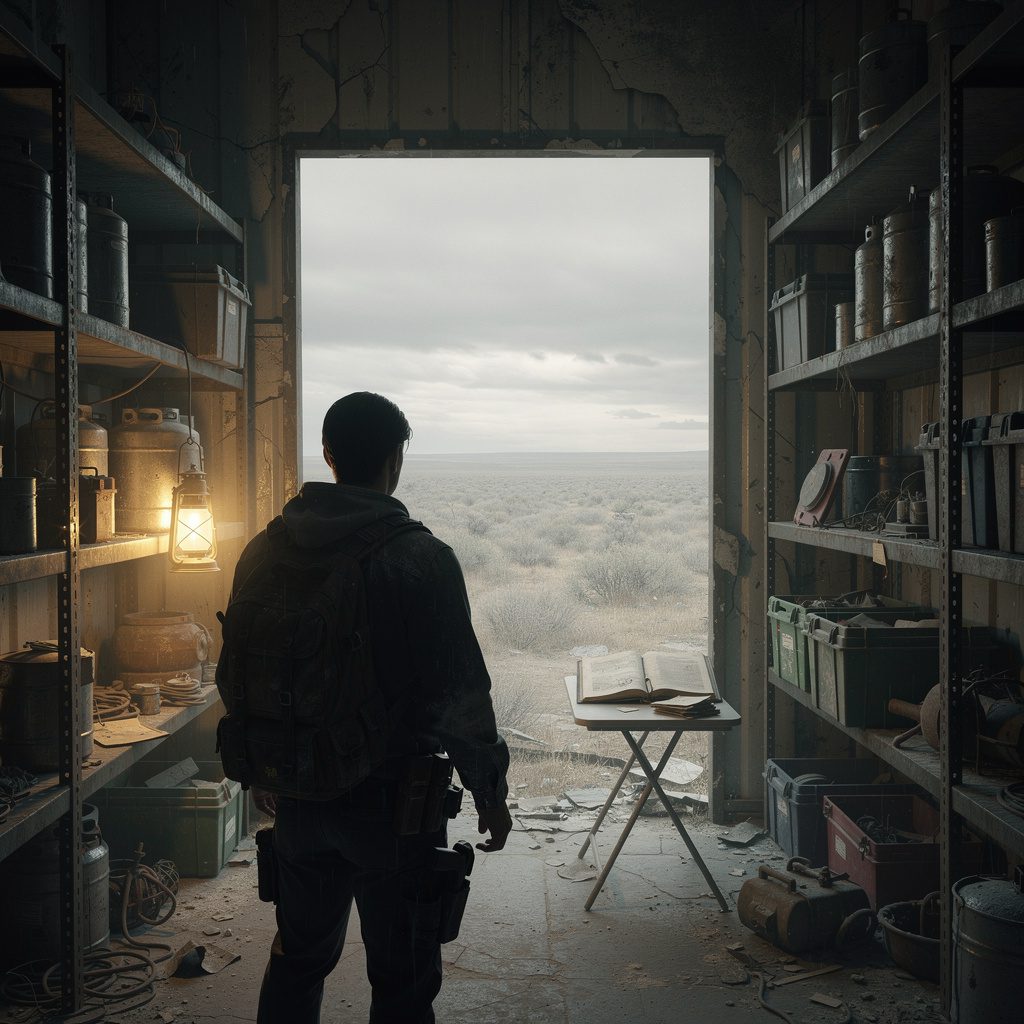
The logbook was open to entry forty-seven when Reem Chamoun found it.
She had not been looking for a logbook. She had been looking for a water reclaimer, or the parts of one, because the cistern beneath the old transit depot had run dry three days ago and the nearest functioning well was eleven kilometers east through open scrubland. But the depot’s lower storage room had given her something stranger than plumbing.
I should tell you what the room looked like, because it matters. The walls were riveted steel plate, the kind used in pre-Collapse prefabricated shelters, painted once in a pale institutional green that had since faded to the color of old bone. Shelves ran the length of two walls, and on those shelves sat canisters, coiled cable, a broken atmospheric sensor, three sealed crates stenciled with a shipping authority that had not existed in forty years. And on a small folding table in the center of the room, under a battery lantern someone had left burning — still burning, after how long? — sat the logbook. Bound in synthetic leather the color of dried blood. Brass clasp. Thick as a fist.
Reem was a salvager by trade and a cataloguer by temperament. She photographed the room before she touched anything, the way her mother had taught her. Then she sat down and read.
Three hundred kilometers north, in what had once been a coastal processing city and was now a slow ruin of salt-eaten concrete and reclaimed marsh, a man named Desmond Rutherford was reading the same logbook.
Not the same physical object — that is impossible, and I want to be precise about what I mean. He was reading a transcription. A copy that had been made, by hand, in a neat and slightly mechanical cursive, and sealed inside a waterproof tube he had pulled from beneath a collapsed jetty two weeks earlier. He was a different kind of searcher than Reem: older, methodical, a former systems archivist for a regional recovery council that had itself collapsed six years ago. He kept notes in a battered tablet with a cracked screen. He cross-referenced. He had been following a thread for eight months.
The logbook — both versions of it — belonged to a vessel called the Ardent Meridian. A mid-range cargo hauler, pre-Collapse registry, last documented run approximately thirty-one years ago. The log covered a journey of forty-two days across what the entries called the Interior Sea Route, moving goods from the northern processing cities down to the southern agricultural settlements before the agricultural settlements stopped needing goods from anywhere.
There were nine crew members listed in the manifest at the front of the log.
The entries mentioned ten.
The tenth crew member appeared first in entry twelve, casually, as though she had always been there. “Karam ran diagnostics on the secondary hull sensor this morning,” the entry read, in the hand of the ship’s navigator. “She says the calibration drift is within tolerance.” From that point forward, Karam appeared in the log every few entries. Checking systems. Eating in the galley. Offering quiet opinions during route discussions. A full, present, textured human being woven into the daily life of a ship. And yet her name did not appear in the manifest. There was no record of her boarding. No record of her leaving.
Reem set the logbook down and pressed her palms flat on the table.
She had salvaged a lot of things. Machines, records, the occasional personal effect that made her feel like an intruder in someone else’s grief. She had never found something that felt like it was watching her back.
I am being careful with language. I want to be accurate.
Desmond had come to the same entry — entry twelve — on his third careful read of the transcription, and had done what an archivist does: he had gone looking for Karam in every other record he could find. Crew registries. Port authority logs. Medical clearance documents from the three cities the Ardent Meridian had called at. He found nothing. Not an absence with a shape to it, the kind that suggests a record was removed. Simply nothing. As if Karam had materialized on the ship somewhere between departure and day twelve, and then — he turned to the final entry, forty-seven, written in a different hand than the rest — ceased to be mentioned at all.

 WhatsApp
 Telegram
 Email







Categories
- AI & Technology
- Contemporary
- Corporate Control
- Creepypasta
- Crime Thriller
- Cyberpunk
- Dark Fantasy
- Enemies to Lovers
- Fairy Tale Retelling
- Fantasy
- First Contact
- Forbidden
- Genetic/Body Horror
- High Fantasy
- Monster Hunter
- Mythic/Folklore
- Paranormal
- Portal/Otherworld
- Post-Apo
- Post-Collapse Society
- Psychological Thriller
- Romances
- SCI-FI
- Second Chance
- Slow Burn
- Space Combat
- Spacepunk
- Surveillance State
- Survival Thriller
- Thrillers
- Time Travel
- Treasure Hunter
- Urban Fantasy
- Witchcraft/Curses
Tags
10min stories atmospheric atmospheric fantasy atmospheric fiction contemporary romance Creepy creepypasta crime thriller dark fantasy debt dystopia emotional fiction enemies to lovers ensemble cast epistolary fantasy female protagonist first person forbidden romance framed narrative high fantasy love story magic Memory mystery Paranormal psychological horror psychological thriller romance sci-fi second chance second chance romance short fiction short story slow burn space station speculative fiction supernatural Survival survival thriller suspense thriller travel romance witchcraft workplace romance
Leave a Reply