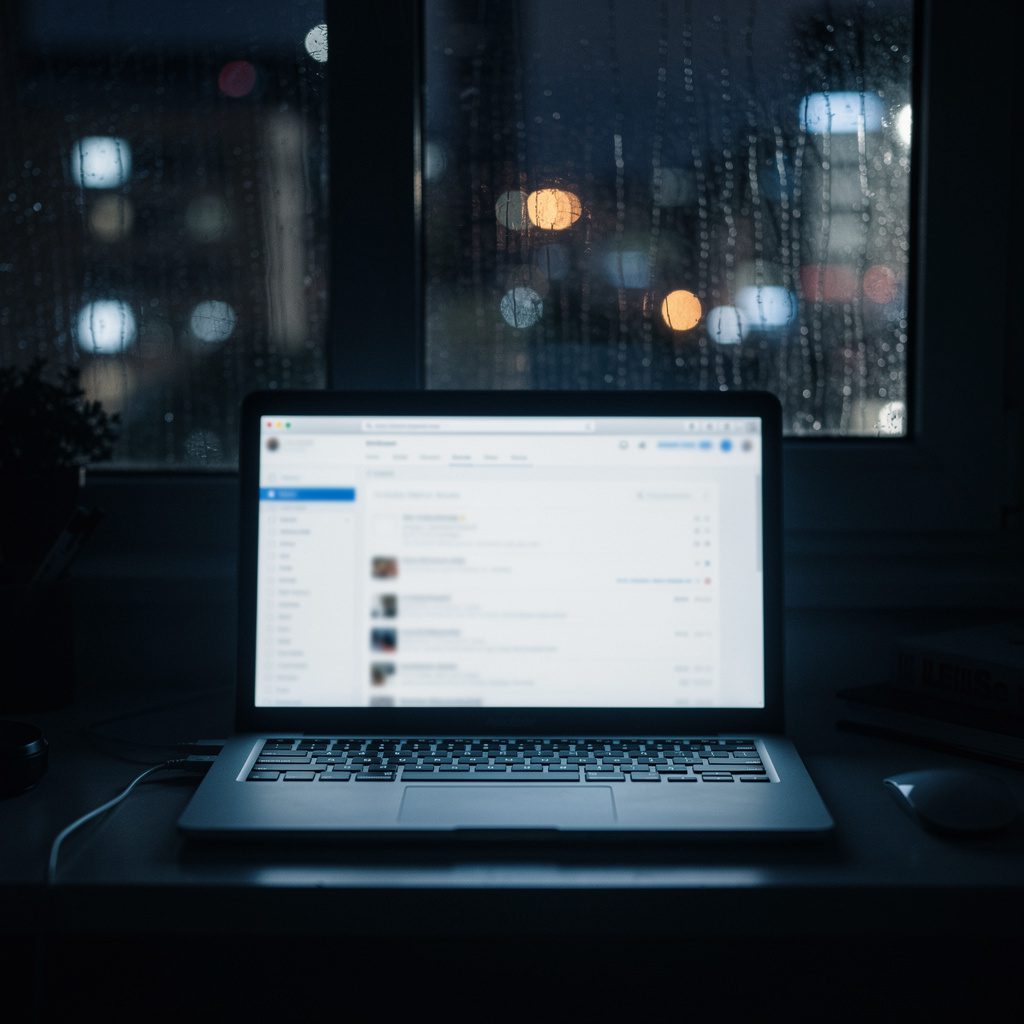
I remember the morning clearly because it was a good one. That matters, I think. It matters that I was happy when it started.
I had made coffee the slow way, with the ceramic pour-over Zofia had given me for my birthday, and I stood at the kitchen window of my apartment in Portland watching rain collect on the glass. The street below was quiet. A woman walked a dog the color of ash. A delivery truck idled at the corner, its hazard lights blinking orange in the grey morning. Nothing unusual. Nothing that should have made my chest tighten the way it eventually would.
I sat down at my desk around nine and opened my laptop. I was a freelance translator — Portuguese and Spanish into English, mostly legal documents, occasionally literary work — and I had a contract deadline in two days. The apartment smelled like coffee and cedar and the faint ghost of last night’s rain coming through the cracked window. It was a good morning. I keep saying that because I need you to understand: I was not looking for trouble. I was not the kind of person things happen to.
The notification appeared at 9:14 AM.
It was from my own email address. The subject line read: “Don’t go to the library today.”
I stared at it for a long moment, that particular kind of stillness that comes before your brain catches up to what your eyes are seeing. I had not sent that email. I checked my Sent folder — nothing. I checked Drafts — nothing. The email existed only in my Inbox, sitting there with my name in the From field like a perfectly calm impossibility.
I told myself someone had spoofed the address. It was the simplest explanation. Spam filters miss things sometimes, and email spoofing is not difficult if you know what you’re doing. I marked it as phishing and went back to my translation work. I managed about forty minutes of actual focus before I opened the email again.
The body of the message was three lines. No greeting. No signature.
“The man in the grey coat has been outside your building since Wednesday. You haven’t noticed him. You will, today. Don’t go to the library.”
Wednesday was two days ago.
I went to the window.
There was no man in a grey coat. The woman with the ash-colored dog was gone. The delivery truck had moved on. The street held only rain and the particular emptiness of a Tuesday morning in November, and I stood there long enough to feel foolish before stepping back and sitting down.
I did not go to the library that day. I told myself it was because I had work to do, which was true, and not because a spoofed email had frightened me, which was also true but less comfortable to admit. I ordered lunch in. I translated forty-seven pages of a land dispute document from Lisbon. I called Zofia in the evening and told her about the email because I needed to hear someone laugh at it, and she did, warmly, and said it was probably a prank from someone who knew my habits.
“You go to that library every Tuesday,” she said. “Anyone who knows you knows that.”
She was right. I felt better. I slept without difficulty.
The second email arrived at 6:52 AM the following morning, again from my own address.
This one read: “You called Zofia last night. That was a mistake. She’ll ask questions now. The man in the grey coat saw your light on until eleven. He’s patient. So am I.”
I sat at the kitchen table with my coffee going cold and I read those four sentences perhaps a dozen times. My hands were steady. That frightened me more than shaking would have, the way my body had decided to be calm about something that should not be calm at all.
Someone knew I had called Zofia. Someone knew my light had been on until eleven. Either my phone was compromised, or my email, or both, or someone had been outside my window with enough patience and proximity to observe the ordinary rhythm of my night. I pulled up my sent mail again. Empty. I checked every folder. The email did not exist anywhere in my account except the Inbox, which meant it had not been sent from my account at all — it had only been made to appear that way.
I opened my curtains two inches and looked down.
A man in a grey coat stood at the corner across the street. He was looking at his phone.
He was always looking at his phone. That’s the thing about surveillance in a modern city — it doesn’t look like surveillance. It looks like a man waiting for a bus, or checking a map, or killing time before a meeting. He was maybe forty, medium build, the coat a dull charcoal that made him look like a smudge against the wet November street. He did not look up at my window. He did not need to.
I stepped back fast enough that I knocked my coffee mug off the table.
I thought about calling the police. I turned it over in my mind the way you turn over a locked box, looking for a handle. What would I say? Someone is sending emails from my address that they apparently haven’t sent, warning me about a man who is standing legally on a public street? I had no evidence of a crime. I had an uncanny feeling and two emails that could, technically, be explained.
I called Zofia instead.
She picked up on the second ring and I told her everything — the second email, the detail about her call, the man at the corner. There was a silence on her end that lasted a beat too long.
“Firas,” she said carefully. “How long has it been since you’ve slept properly?”
I told her I’d slept fine. She didn’t sound convinced. She suggested, gently, that stress could make patterns where there weren’t any, that the email sender might have guessed about the call, that the man at the corner was almost certainly nobody. I listened to all of it and said the right things and hung up and stood in the middle of my kitchen feeling the particular loneliness of someone who has seen something real and cannot make anyone else see it.
I did not go outside that day either.
The third email arrived at 2:17 AM.
I was awake when it came. I’d been lying in the dark listening to the rain, caught in that uncomfortable space between tired and wired that anxiety opens up like a trapdoor. My phone buzzed on the nightstand and I picked it up and the notification was already there, white text on a dark screen: new message, from myself.
“You’re awake. Good. You’re starting to understand. Don’t contact Zofia again — not because she’s in danger, but because she can’t help you. Nobody can help you the way you’re hoping. The library matters. You need to understand why you were told not to go. Think about what you were supposed to find there.”
I sat up in bed.
The message had a timestamp of 2:17 AM. I checked my phone logs: the notification had buzzed me at 2:17 AM. But when I opened the full email and looked at the header data — the routing information buried in the technical details that most people never read — the message had been sent at 2:09 AM.
Eight minutes before I was awake to receive it, I understood.
But there was something else in the header. A ghost timestamp buried two lines below the send date, the kind of artifact that appears when an email is queued or pre-scheduled. This one read: October 31st. Eleven days ago.
The message had been composed eleven days ago. Scheduled. Sent eight minutes before I woke to read it, apparently timed to reach me in the small hours of a specific sleepless night. Eleven days ago, someone had known I would be awake at 2 AM on this particular Tuesday in November. Or they had sent a sequence of emails timed to arrive in stages, and this was simply the one that fit.
Or something else. Something I didn’t have a word for yet.
I got dressed. I don’t know why — some animal logic, the instinct to be ready to move. I sat in my desk chair with the lamp on low and opened a blank document and started writing down everything: dates, times, exact wording of each email, the header data, the man in the grey coat. I wrote for over an hour. It helped, the way that giving shape to a formless fear sometimes helps. It didn’t make me feel safe. It made me feel like I was doing the only thing left to do.
At dawn I looked up the Portland Central Library online. I went through the events calendar for the past week, then the week before. A visiting archivist from Lisbon had given a lecture on Tuesday — the Tuesday I had been told not to go. His name was listed on the university partnership page with a small photograph. I stared at the photograph for a long time.
I recognized him.
Not from life. From a document I had translated eight months ago — a legal deposition related to a property dispute that had, at the time, seemed entirely routine. He had been a witness in that case. His name in the deposition was different from the name on the library event page. Both could be legal names. People have more than one legal name sometimes, especially across jurisdictions. But the face was the same.
I closed the laptop.
I opened it again and searched for the man’s name from the deposition. The results were thin and strange: a mention in a Portuguese property registry, a brief reference in an archived news article from 2019 about a fraud investigation that had apparently gone nowhere, and a single academic paper on land title disputes in the Alentejo region. Nothing alarming on its own. Everything slightly off in aggregate, the way a painting looks wrong before you can identify which element is wrong.
I sent Zofia one last message. Not a call — a text, brief: “I’m okay. Don’t worry. I need a few days.”
Then I sat and waited.
No fourth email came that morning. Not that afternoon. I ate crackers and cheese standing at the kitchen counter and watched the street from two inches of open curtain. The man in the grey coat did not reappear. The corner held only wet pavement and the slow drift of leaves that had been dead since October.
At 7 PM, a new email arrived. Same address. My own name in the From field.
The subject line: “Good.”
The body: nothing. Blank white space below the subject line, no text, no hidden characters when I highlighted the field, just emptiness that had been sent to me from myself eleven days ago or eight minutes ago or at some point that the timestamps could not agree on.
I printed the email. I printed all the emails, all the header data, the archivist’s photograph, the deposition pages. I put them in a folder and I put the folder in my bag.
I still don’t know what I was supposed to find at the library. I don’t know if the archivist from Lisbon was connected to the deposition, to me, to whoever sent those emails. I don’t know if the man in the grey coat was watching me or simply existing at a corner I had suddenly decided was significant. I don’t know if the emails were sent by a person with foreknowledge, or scheduled by a system I can’t map, or produced by something I have no category for.
What I know is this: the timestamps don’t fit. Not if you believe time works the way we’ve agreed it works. The first email warned me about a man I hadn’t yet noticed. The third email was written before any of the events it referenced had occurred. Either someone knew exactly what was coming — my call to Zofia, my sleepless night, the specific shape of my fear — or the messages weren’t sent from the future at all.
They were sent from somewhere else entirely.
I still check my Inbox every morning. I still look at the From field first. Most days it’s normal — client emails, invoices, a newsletter I keep meaning to unsubscribe from. But sometimes I pause over a message I don’t remember writing, trying to recall if I drafted it in a distracted moment, some tired afternoon when my hands moved without my full attention.
So far, I’ve always found an explanation.
So far.

 WhatsApp
 Telegram
 Email






Leave a Reply