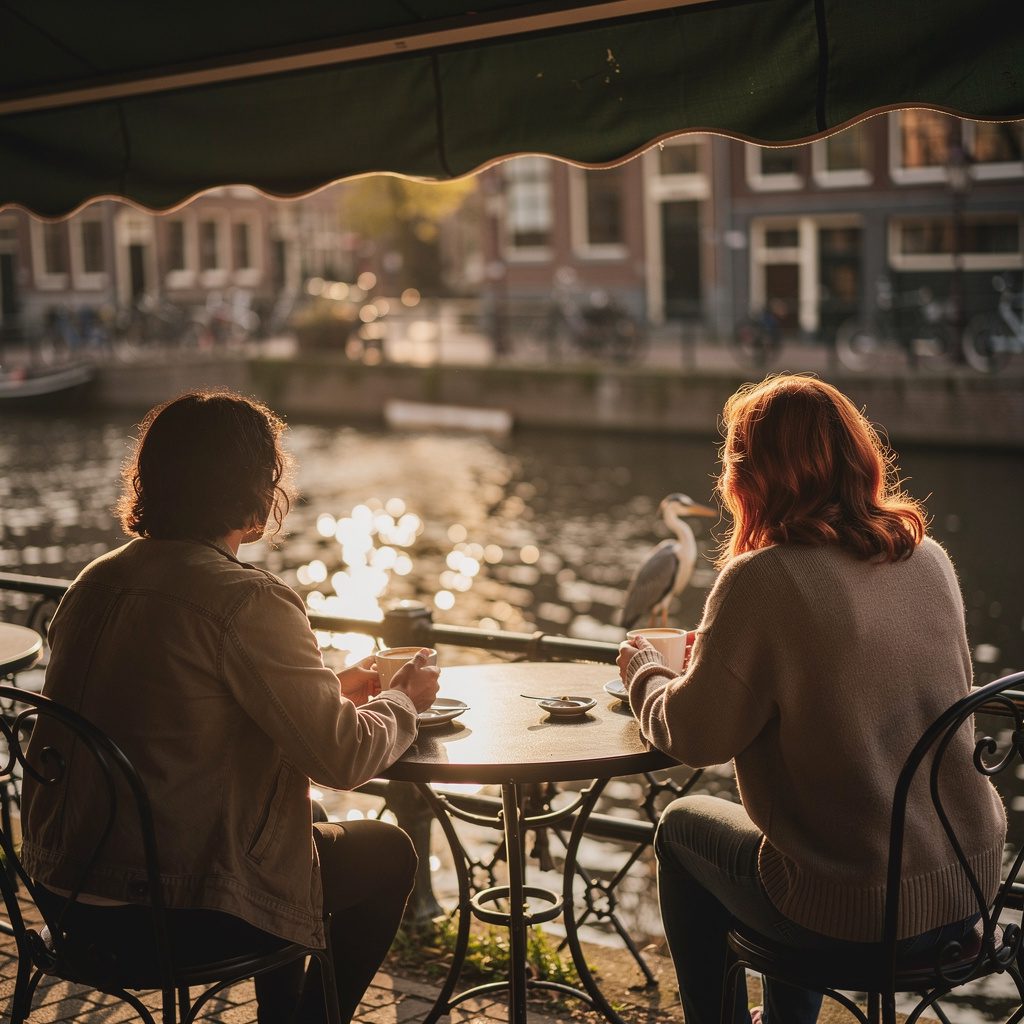
The paint scraper slips from Ananya’s hand and clatters against the floorboards, and for a moment neither of them moves.
Gunnar is standing too close. She knows this. He knows this. The afternoon light coming off the canal outside turns his hair the color of old copper, and she has not looked directly at him in three days, and now she is looking, and he is looking back, and the wallpaper she was halfway through stripping hangs off the wall in a long, wounded curl behind her.
“You don’t have to do it like that,” he says. His voice is careful. Like someone walking across ice they’re not sure will hold.
“I know how to strip wallpaper, Gunnar.”
“I didn’t say you didn’t.”
She picks up the scraper. He doesn’t move away.
—
Six weeks ago, Ananya was sitting at a canal-side café in Amsterdam—the one with the green awning and the wobbling iron chairs—when her phone rang and a solicitor’s voice told her that her grandmother’s house in the Jordaan had been left jointly to her and to Gunnar Engebretsen, her grandmother’s neighbor’s son, who had apparently spent three summers helping the old woman with her garden and her groceries and her crossword puzzles while Ananya was busy living her life in London.
She’d sat there with her coffee going cold, watching a heron stand perfectly still on the opposite bank, and thought: of course.
Of course it would be Gunnar.
She’d met him nine years ago, at her cousin’s engagement party in this same city. He was tall and unhurried and had a habit of listening to people like they were the only thing in the room worth paying attention to. She’d fallen for him over the course of a single long evening, somewhere between the second bottle of wine and the moment he’d walked her back to her grandmother’s front door and said, very quietly, “I’d like to see you again.”
They’d had two years. Good ones. And then she’d taken the job in London, and he’d had reasons to stay, and they’d told each other it would work, and it hadn’t, and eventually the calls had gotten shorter and the silences had gotten longer and one morning she’d woken up knowing it was over without either of them having said so.
She hadn’t spoken to him in six years.
And now they own a house together.
—
The house needs everything. New plumbing. New wiring. The kitchen is a disaster of avocado-green tile and a ceiling that sags in one corner like it’s tired of trying. The will stipulates—through some quirk of her grandmother’s iron-willed sentimentality—that the property cannot be sold until it has been “restored to a livable standard,” a phrase the solicitor delivered with the mild embarrassment of someone who knows it will cause problems.
Gunnar had been standing outside the house when she arrived, hands in his jacket pockets, looking at the front door like it owed him something.
She’d said his name. He’d turned.
The six years had done something to his face—not aged it exactly, but settled it. He looked more like himself, somehow. Less like a person still figuring out what he was.
He’d said, “Ananya.” Just that.
And she’d thought: this is going to be very hard.
—
They’d established rules. Practical ones. She takes the mornings, he takes the afternoons. They leave notes for each other on the kitchen counter—the tile guy is coming Thursday, the hardware store on Prinsengracht has the right size hinges—and they are polite in the way that people are polite when politeness is the only wall they have left.
It is Manoj who complicates it.
Manoj Agarwal is Ananya’s ex. Not a bad person—she wants to be clear about that, even in her own head—just a person she’d been with for two years in London, who had been kind and steady and ultimately wrong for her in a way that had taken her too long to name. He’d called twice since she arrived in Amsterdam. The second time, Gunnar had been in the kitchen when her phone lit up with Manoj’s name, and she’d watched something move across Gunnar’s face before he turned back to the cabinet he was measuring.
She didn’t answer.
She didn’t explain why she didn’t answer.
Gunnar didn’t ask.
That was three days ago, and since then the politeness has developed a texture—something tighter, more careful, like fabric pulled too taut.
—
So now they are standing in the bedroom that used to be her grandmother’s sewing room, and the wallpaper is coming off in long strips, and Gunnar has not moved away, and Ananya’s heart is doing something she doesn’t have a name for.
“You’re supposed to wet it first,” he says. “With the spray bottle. It comes off cleaner.”
“I know.”
“Then why aren’t you—”
“Because I forgot, Gunnar. I forgot about the spray bottle. I’m allowed to forget things.”
He goes quiet. She turns back to the wall and presses the scraper blade against the seam and pushes, and a piece comes away in a satisfying sheet, and she feels slightly better.
Then he says, very quietly: “Who’s Manoj?”
The scraper stops.
She doesn’t turn around. “Someone I used to see. In London.”
“Used to.”
“Used to.”
A pause. Outside, a canal boat moves past the window, and the reflected light ripples across the ceiling in slow, wavering lines.
“He’s called twice,” Gunnar says.
“I know how many times he’s called.” She finally turns. “I didn’t answer.”
He looks at her steadily. There is something in his expression she can’t quite read—not jealousy exactly, or not only that. Something older. “Why are you telling me that?”
“Because you’re clearly wondering.”
“I wasn’t—” He stops. Exhales. “Okay. I was wondering.”
This is the first honest thing either of them has said in a week, and it lands in the room like something dropped from a height.
—
They end up at the café with the green awning.
It’s not a decision so much as a mutual exhaustion—they’ve been working since eight in the morning, and the light is going amber outside, and at some point Gunnar had said “coffee?” and she’d said “yes” without thinking, and now they are sitting at one of the wobbling iron tables with the canal right there, close enough to hear the water.
Ananya wraps both hands around her cup. The coffee is good. It has always been good here. Her grandmother used to bring her to this café when she was small, and she’d have hot chocolate and her grandmother would have a single espresso and they’d watch the boats.
She tells Gunnar this. She’s not sure why.
He listens the way he always listened—completely, without waiting for his turn to speak. When she finishes, he says, “She used to talk about you. A lot. Even after—” He pauses. “Even after we stopped talking.”
“What did she say?”
“That you were doing well. That you were stubborn.” A small smile. “In that order.”
Ananya laughs—a real one, surprised out of her. “That sounds right.”
The smile stays on his face a moment longer than she expects.
She looks away, at the canal. A couple walks along the opposite bank, close together, the woman leaning slightly into the man’s shoulder. The water is very still. A bicycle bell rings somewhere behind them.
“I should have called,” she says. “When she got sick. I knew she was sick and I kept thinking I’d come next month, and then—” She stops. The familiar guilt, worn smooth now from years of handling.
“You came for the end,” Gunnar says. Not as absolution. Just as fact.
“You were there too.” She’d known this from the solicitor. Known it and felt something complicated about it that she’s been avoiding examining.
“She asked me to be.” He wraps his hands around his own cup. “She was—she was easier to be around than most people. She said what she meant.”
Ananya thinks of her grandmother’s handwriting on the will, the old-fashioned loops of it. The very specific, very deliberate instruction about the house. “She did this on purpose,” Ananya says. “The joint inheritance. She knew what she was doing.”
Gunnar is quiet for a moment. “Probably.”
“Does that bother you?”
He looks at her. The amber light is doing things to the canal behind him, turning it gold. “No,” he says simply. “Does it bother you?”
She considers lying. Considers the six years, and the notes on the kitchen counter, and the way he said her name when she arrived—just that, just “Ananya,” like the word itself was enough.
“No,” she says.
—
They walk back to the house as the streetlights come on, one by one, their reflections appearing in the canal below like a second, quieter city. Ananya’s shoulder almost touches his. Almost.
At the front door, she fumbles with the key—the lock is old and needs coaxing, another thing on the list—and Gunnar reaches past her, not to take the key but to hold the door frame steady, because it shifts when you turn the lock and you have to know to brace it. He knows to brace it. She didn’t know he knew.
“Thank you,” she says.
“Thank your grandmother,” he says. “She taught me.”
The door opens. The house smells of plaster dust and old wood and faintly, underneath it all, of the rose water her grandmother kept in a dish on the windowsill. Ananya breathes it in.
She turns to say something—she’s not sure what, something about the wallpaper, about tomorrow, about the tile guy on Thursday—and finds Gunnar looking at her with an expression that is not quite a question but is also not quite not one.
She thinks about six years. She thinks about the way things end without ceremony, without a clear last word, just a gradual quieting until silence fills all the space where something used to be.
She thinks about her grandmother, who said what she meant.
“The bedroom needs another two hours tomorrow,” she says. “If you want to help with the wallpaper.”
Something in his face eases. “I’ll bring the spray bottle,” he says.
She nods. Steps inside.
Behind her, she hears him follow, and the old door swings shut behind them both, and the canal goes on its quiet way outside, and the house holds them, for now, like it always meant to.

 WhatsApp
 Telegram
 Email






Leave a Reply