I have counted the losses. That is, after all, what I do.
My name is Snikkle Mapclaw, and I have mapped stranger places than this — goblin warrens that fold back on themselves, market tunnels that charge you twice for the same corridor, a staircase in the Underbramble that descends for six days and deposits you exactly where you started with lighter pockets. But I have never mapped a door that breathes. And I have never, in thirty-seven years of cartographic enterprise, watched someone walk through one.
Until Simisola.
—
The town of Ashkelm sat at the edge of what the locals called the Greymarsh — a wide, flat expanse of pale reeds and standing water that caught the light wrong, always wrong, as if the sun above it were slightly secondhand. The buildings were stone and dark timber, their rooflines sagging like tired shoulders. The people were polite in the way that people are polite when they have agreed, collectively, not to talk about something.
Simisola Asante arrived on a Tuesday, which is a terrible day to arrive anywhere. She came on foot, carrying a pack that sat too high on her shoulders and a leather satchel worn soft with use. She was a tall woman in her late thirties, her face angular and deliberate, her dark skin dusted with the pale clay of the northern road. She walked like someone who had been walking for a long time and had stopped expecting the walk to end.
She had come looking for a door.
Specifically, she had come looking for the door that her brother Kofi had walked through eleven months ago and not come back from.
She had his last letter in her satchel. She had his notes, his sketches, his half-finished map of the Greymarsh’s inner channels. She had the name of a woman in Ashkelm who reportedly knew things. And she had, as the letter had warned her she would need, something she had already lost.
She had the grief. She had brought plenty of that.
—
Eleven months earlier, a man named Kofi Asante had stood in the same town and spoken to the same woman.
Her name was Thalys Windmere, and she kept a peculiar shop at the end of Ashkelm’s only real street — a place that sold maps, instruments of measurement, and, if you asked the right way, information. The shop smelled of beeswax and old paper and something faintly mineral, like wet stone in a cave. Thalys herself was a woman of perhaps sixty, with the long, slightly luminous fingers of someone who had spent decades handling things that gave off faint light. Her ears were slightly too pointed at the tip to be entirely human, though no one in Ashkelm was impolite enough to mention it.
Kofi had been direct. He was a researcher, a documenter of thresholds and liminal spaces — places where one kind of world pressed against another. He had tracked six separate accounts of a door in the Greymarsh that opened onto something else entirely. Not a room. Not a cellar. Something else.
“Six accounts,” Thalys had said, not looking up from the lens she was cleaning. “There are seven. You missed the innkeeper’s grandmother’s journal, which is not in any archive because she kept it in a jar of pickled onions.”
Kofi had stared at her.
“The seventh account is the only one that mentions the condition,” Thalys continued. “The door opens for someone who has already lost something they cannot get back. Not something taken. Not something misplaced. Something genuinely, irreversibly gone.”
Kofi had been quiet for a moment. Then he asked where the door was.
Thalys had told him. She had also told him to bring a rope, a reliable light source, and someone who loved him enough to come after him if he didn’t return.
He had brought the rope and the light. He had not brought the other thing.
That was the mistake.
—
I was in the shop when Simisola came in. I will be honest: I had been in the shop for three days by then, conducting what I prefer to call a cartographic consultation and what Thalys preferred to call “loitering with a ledger.” The door’s existence was, from a commercial standpoint, extraordinary. A portal to another world, operating on a grief-based admission mechanism — the licensing potential alone was staggering. I had fourteen pages of preliminary notes.
Simisola walked in without knocking, which is the correct way to enter a shop, and placed her brother’s letter on the counter without preamble.
“You spoke to him,” she said.
Thalys looked at the letter. Then at Simisola. Then, briefly, at me — which I found unnecessary, as I was being very quiet in my corner.
“I did,” Thalys said.
“Tell me where the door is.”
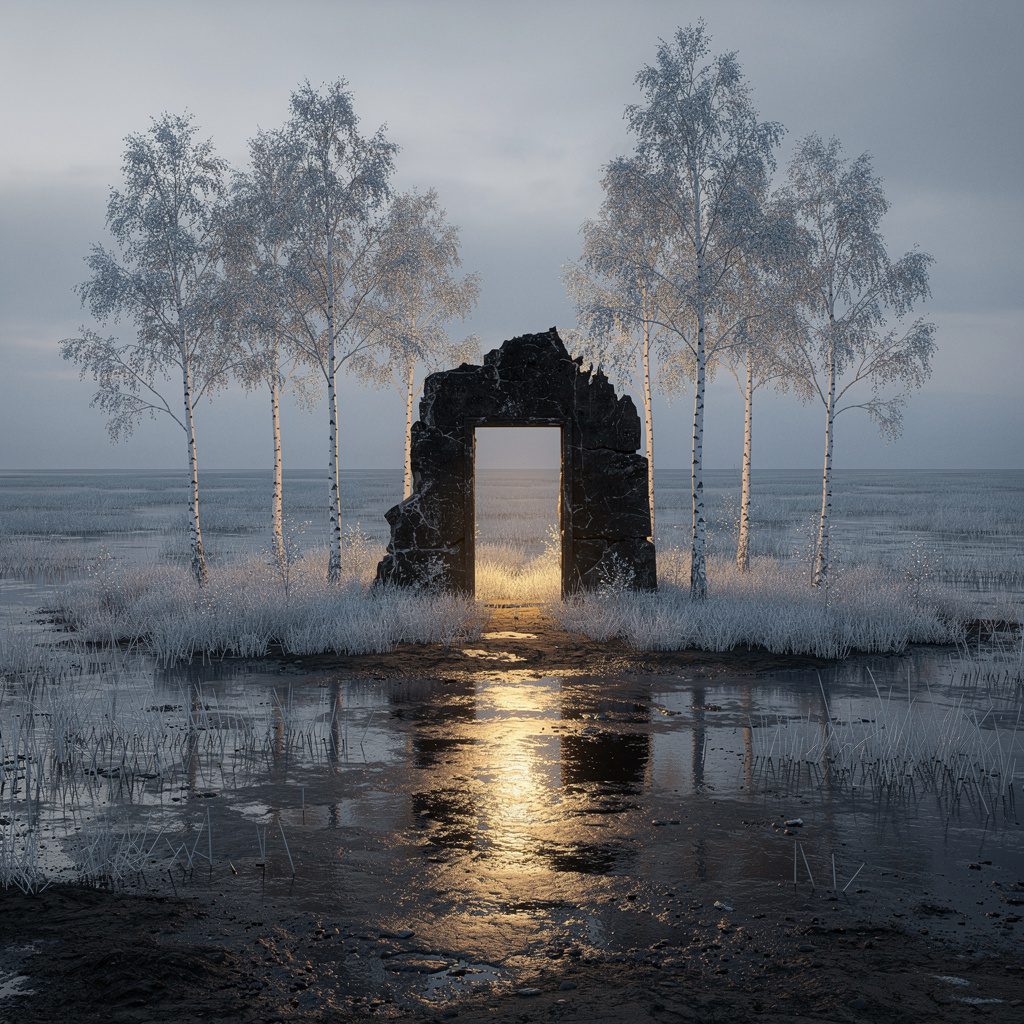
“I’ll tell you what I told him,” Thalys said. “The door is in the Greymarsh, two hours east on the reed-path, at the place where the water runs in a perfect circle around a stand of white birch. You will see a frame of black stone, no taller than a doorway, standing alone in the water. It will look like a ruin. It is not a ruin.” She paused. “It will not open for curiosity. It will not open for determination. It opens only for someone who carries a loss that cannot be undone.”
Simisola’s jaw tightened. “I know what I’ve lost.”
“I know you do,” Thalys said gently. “That’s why I’ll tell you the rest.”
—
The Greymarsh in late afternoon was a place of extraordinary, unsettling stillness. The reeds stood without swaying. The water between them held a flat, pewter light. Simisola moved along the raised reed-path with her pack and her satchel and a lantern she hadn’t lit yet, because there was still enough grey light to navigate by, and she was conserving.
She had Kofi’s sketch of the route. She had her own sense of direction, which had always been better than his. She had the feeling, growing steadily since she’d left the town’s edge, that something was watching her.
She was not wrong about that.
—
I should clarify, for the record: I was not following her. I was conducting a parallel survey of the same route for independent professional reasons. The fact that I was moving quietly and staying low in the reeds was purely a function of the terrain.
She heard me anyway, of course. She stopped, turned, and looked directly at the clump of reeds I was occupying.
“Whatever you are,” she said, “come out or stay behind. I don’t have time for half-measures.”
I came out.
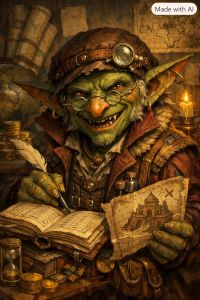
I am, as I may not have adequately described, a goblin — specifically of the Ashclaw warrens, though I have been told I carry myself with more dignity than that implies. I stand roughly four feet tall, with the characteristic grey-green complexion of a deep-warren goblin, ears that angle outward at forty-five degrees, and eyes of a yellow that I have always considered quite striking. I was wearing my best cartographer’s coat, which has seventeen pockets and a hood, and I was carrying a surveying instrument of my own design.
Simisola looked at me for a moment.
“You’re the one from the shop,” she said.
“Snikkle Mapclaw,” I said. “Cartographer, treasurer, and — on an entirely voluntary basis — your escort for the remainder of this route.”
“I didn’t ask for an escort.”
“No,” I agreed. “But your brother did. He asked Thalys to send someone after him if he didn’t return. She asked me three days ago. I’ve been waiting for someone to follow.”
That stopped her.
She looked at me for a long moment, and I watched something shift in her face — not softening exactly, but a recalibration, a quiet adjustment of the weight she was carrying.
“He thought of that,” she said. “Just not soon enough.”
“No,” I said. “But you’re here now.”
We walked on together.
—
The door was exactly where Thalys had said it would be.
It stood in a ring of dark water, surrounded by seven white birch trees whose bark was almost luminous in the failing light. The frame was black stone, old enough that it had begun to look like a natural formation — two upright slabs and a lintel, carved with symbols that I recognized from the seventh account (the pickled-onion journal, which Thalys had, bless her mercantile soul, photographed for my reference). The space between the stones was not empty. It held something — not darkness exactly, but a quality of depth that didn’t match the flat marsh behind it. Looking through the frame from this side, you could see what appeared to be a corridor of pale light, narrow and very long, bending slightly at the far end as if the world on the other side curved differently.
Simisola stood at the edge of the water and looked at it for a long time without speaking.
“Kofi went through that,” she said finally. It was not a question.
“According to the account I have,” I said, “yes. Eleven months ago.”
She waded into the ring of water without hesitating. It came to her knees, cold enough that her breath caught, but she didn’t slow. She reached the door and stood before it and placed her palm flat against the black stone of the frame.
Nothing happened.
She stood there. I watched from the bank. The marsh was absolutely silent.
Then she said something quietly — not to me, not to the door, but to the air, or to herself, or to someone who wasn’t there anymore. I didn’t catch the words. I don’t think I was meant to.
The door opened.
—
I have seen a great many things in my career. I have seen a map that updated itself in real time, which was commercially very exciting until we realized it was drawing from a future that wasn’t guaranteed. I have seen a room that was larger inside than out by a factor of twelve, which I measured carefully and invoiced accordingly. I have seen things in goblin warrens that I will not describe because they are proprietary.
But I have never seen light come through a door the way it came through that frame.
It was warm and gold and slightly too bright, like afternoon in a place where afternoons last longer. It smelled of dry grass and something sweet and distant, like a bakery three streets away. And from somewhere inside it, after a moment, came the sound of footsteps.
Two sets.
One was Simisola’s, moving inward.
The other was moving out.
—
Kofi Asante came through the door eleven months thinner and considerably more sunburned, blinking in the grey marsh light with the expression of a man who has been somewhere so different that ordinary things have temporarily stopped making sense. He was carrying his original pack, his rope, and a flat stone covered in dense, careful writing that he clutched against his chest like something precious.
He stopped when he saw me.
“You’re a goblin,” he said.
“Astute,” I said. “Your sister is currently walking in the direction you just came from.”
His face changed entirely.
He turned back to the door, but it had already closed — not slammed, not vanished, simply settled back into its quality of depth, the pale corridor no longer visible. He pressed his hand to the stone and nothing happened, because he had come back, because he had returned, and the loss that had opened the door for him was no longer the same shape it had been.
He stood there with his hand on the stone for a long moment.
I was about to explain the situation — the conditions, the mechanism, the likely duration of transit based on the accounts — when the door opened again from the other side.
Simisola came through first. She was wet to the knee and her lantern was lit now, burning gold, and she was half-turning back to say something over her shoulder with an expression I can only describe as exasperated affection, which is, in my experience, the default expression of someone who has just found a person they love doing something inadvisable.
Kofi made a sound I will not try to transcribe.
They met in the water, in the ring of white birches, in the last of the grey marsh light. She grabbed the front of his coat with both hands. He pressed his forehead against hers. Neither of them said anything for a long moment, and I, being a professional with seventeen pockets and a great deal of experience knowing when a scene does not require a ledger, stayed on the bank and updated my survey notes.
The door, behind them, stood quiet and still.
I noted, for the record, that it remained open.
Not wide — just slightly ajar, the way a door stays when someone has passed through it and not yet decided whether they are done with the room. The pale corridor light spilled out in a thin line across the dark water, gold against pewter, steady as a lamp left burning for someone expected home.
I drew it carefully in my map. A door in a ring of seven birches, in a marsh at the edge of a town with a name like a sigh. Open. Attended.
I labeled it, in my smallest and most precise script: *The Door That Waits.*
It seemed accurate.

 WhatsApp
 Telegram
 Email




Leave a Reply