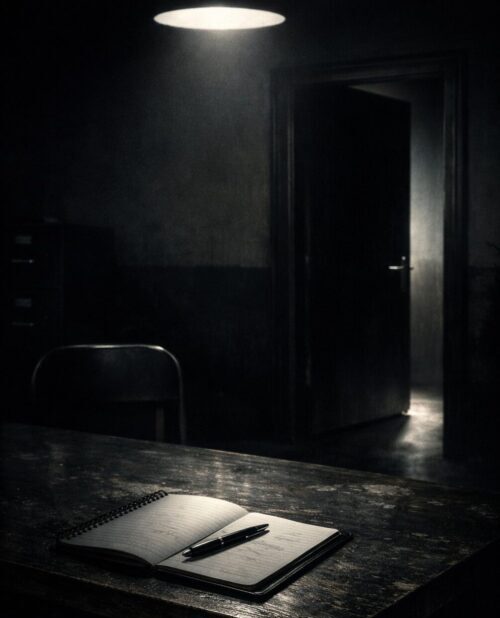
The detective on my doorstep said my testimony could close the case. The problem was, I had never witnessed anything.
I told him that. He smiled and wrote something in his notebook anyway.
Detective Roy Marsh was the kind of man who made small rooms feel smaller. Broad shoulders, quiet eyes, the sort of patience that felt less like calm and more like strategy. He stood in my narrow hallway and told me a woman named Elise Farmer had been murdered three nights ago, two streets from my apartment, sometime between eleven and midnight.
“Neighbours put a light on in your front window around that time,” he said. “You would have had a clear sightline to the alley.”
“I was asleep by ten,” I said.
He wrote that down too.
My name is Owen Pace. I teach secondary school history and I own too many houseplants and I have never once in my forty-one years been interviewed by the police. I made Marsh a coffee he didn’t touch and answered every question he asked, and when he left I stood at my front window and looked at the alley between the dry cleaner’s and the shuttered off-licence.
It was narrow. Badly lit. You could see it from my window, just barely, if you stood at the right angle.
I had been asleep by ten. I was certain of it.
But I stood there for a long time, looking at the alley, and something at the edge of my memory moved. The way a fish moves under dark water. Present and gone before you can name it.
I closed the curtain and told myself it was nothing.
The next morning I found a note under my door.
White envelope, no name on the outside. Inside, one sentence printed in plain type:
You saw more than you think. Stay quiet and stay safe.
I read it three times. Then I photographed it, put it in a kitchen drawer, and called Marsh’s number. It rang out. I left a message. He didn’t call back.
That afternoon I went to the school, taught two classes on the causes of the First World War, and tried to feel normal. On my way home I passed the alley.
There was a bunch of flowers against the wall. Cellophane-wrapped, already wilting. Someone had taped a photograph to the brick above them.
Elise Farmer was thirty-four. Dark hair. A wide, open smile. She looked like someone who laughed easily.
I stood on the pavement and looked at her photograph and the dark water in my memory moved again. Closer this time.
I couldn’t sleep that night. I sat in the chair by the front window in the dark, not deliberately watching, just unable to lie down. The street outside was empty and orange-lit and very still.
At half past midnight a car pulled up across the road. It idled there for four minutes — I know because I watched the clock on my phone. Then it moved on.
I went to bed and lay on top of the covers and made myself think.
Three nights ago. Before ten. I had been reading in this same chair. I remembered finishing the chapter, remembered marking the page. What I had not remembered, until this precise moment at 1 a.m. in the dark of my own bedroom, was what I had seen when I’d leaned over to put the book on the side table.
Movement in the alley.

 WhatsApp
 Telegram
 Email






Leave a Reply