I leave at seven in the morning, same as always.
The car is warm. The coffee is in the cupholder. The GPS shows a clean blue line stretching northwest out of Asheville, through the mountain roads, toward the interstate.
I have done this drive a hundred times.
The trees on either side of Route 9 are dense and dark even in daylight, the kind of forest that swallows sound. I like it. I turn off the radio and just drive.
At the first junction I take the left fork, the way I always do.
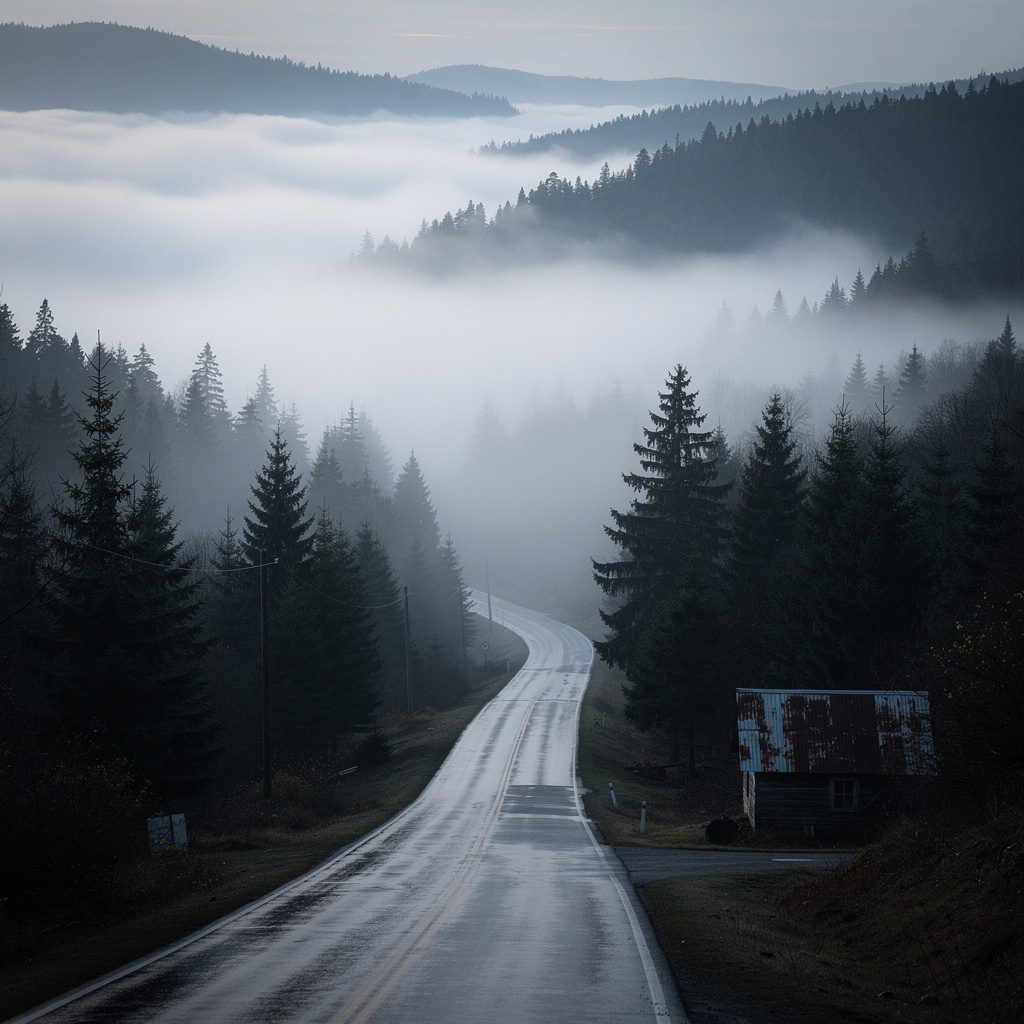
Twenty minutes later I pass the old grain mill. Rust-red tin roof. The broken weathervane that never moves. I have always used it as a landmark, a sign that I am making good time.
I do not think anything of it.
Not yet.
The road curves long and easy around the ridge. The morning fog is still sitting in the low places between the hills, thick and white, and through it the tree trunks look like columns holding up nothing.
I finish my coffee.
I pass a yellow road sign, diamond-shaped, warning of a curve ahead. The paint is faded almost to nothing. I remember noticing it last month and thinking someone should repaint it.
I think the same thing now.
The interstate should appear in about ten minutes. The overpass, the on-ramp, the sudden widening of the world.
I check the GPS. It says eight minutes.
Eight minutes pass.
I am looking for the overpass when the grain mill appears on my right.
Rust-red tin roof. Broken weathervane.
I slow down.
I look at it the way you look at something that should not be there. Carefully. Like looking too fast might change what you see.
It is the same mill. The same broken arm on the weathervane, bent at the same angle, pointing at nothing.
I pull over onto the gravel shoulder and sit with the engine running.
The GPS is recalculating. The blue line shifts, redraws itself, points me forward again.
I tell myself I must have made a wrong turn somewhere without noticing. These mountain roads all look the same. It happens.
I pull back onto the road and follow the GPS.
At the junction I take the left fork.
I drive.
When the mill appears again I do not slow down this time. I press the accelerator and watch it slide past in the mirror until the road curves and takes it from view.
My hands are steady on the wheel. I am not a person who panics.
I call Viggo.
He picks up on the second ring, which surprises me. Viggo is not a morning person. His voice is level, unhurried, like he has been awake for hours.
“You get turned around?” he says.
I pause. “How did you know I was calling about that?”
A beat of silence. “You said you were driving this morning. Mountain roads are tricky.”
That is a reasonable explanation. Viggo is a reasonable person. I have known him for eleven years, since we were both working out of a surveying office in Knoxville. He knows these roads.
“I keep passing the same mill,” I say. “The one with the tin roof. I’ve gone past it three times.”
“Turn around,” he says. “Go back toward town and take Route 12 instead.”
“I’ve never taken 12.”
“It connects the same way. Just go.”
His voice has a quality I cannot name. Not urgency. Something quieter than urgency. Something that sits underneath it.
I turn around.
I drive back toward Asheville with the morning sun now directly in my eyes, the visor down, the road ahead bright and difficult to read.
I find Route 12. The sign is older than I expect, the numbers raised and painted green, one corner bent away from the post. I turn onto it.
The road is narrower here. The trees press closer.
For a while everything is fine. The road climbs, then levels, then descends through a long straight stretch where the fog has not lifted yet and the world is just gray and white and the sound of my tires.
Then I see the grain mill.
I stop the car in the middle of the road.
There is no other traffic. There has been no other traffic this entire morning, I realize. Not one other car. Not in either direction. Not on Route 9, not on the way back, not on Route 12.
I get out.

 WhatsApp
 Telegram
 Email







Categories
- AI & Technology
- Contemporary
- Corporate Control
- Creepypasta
- Crime Thriller
- Cyberpunk
- Dark Fantasy
- Enemies to Lovers
- Fairy Tale Retelling
- Fantasy
- First Contact
- Forbidden
- Genetic/Body Horror
- High Fantasy
- Monster Hunter
- Mythic/Folklore
- Paranormal
- Portal/Otherworld
- Post-Apo
- Post-Collapse Society
- Psychological Thriller
- Romances
- SCI-FI
- Second Chance
- Slow Burn
- Space Combat
- Spacepunk
- Surveillance State
- Survival Thriller
- Thrillers
- Time Travel
- Treasure Hunter
- Urban Fantasy
- Witchcraft/Curses
Tags
10min stories atmospheric atmospheric fantasy atmospheric fiction contemporary romance Creepy creepypasta crime thriller dark fantasy debt dystopia emotional fiction enemies to lovers ensemble cast epistolary fantasy female protagonist first person forbidden romance framed narrative high fantasy love story magic Memory mystery Paranormal psychological horror psychological thriller romance sci-fi second chance second chance romance short fiction short story slow burn space station speculative fiction supernatural Survival survival thriller suspense thriller travel romance witchcraft workplace romance
Leave a Reply