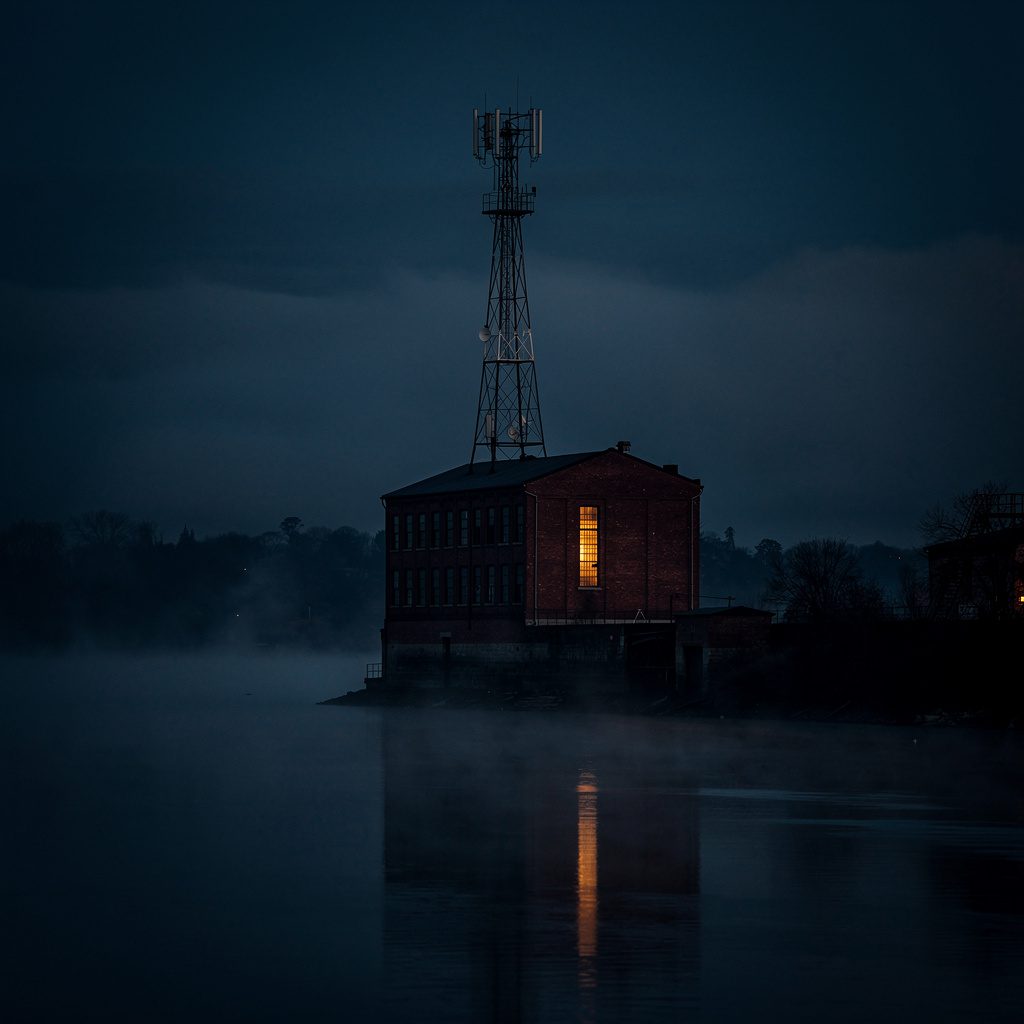
The first thing I noticed was the smell of burnt coffee. Not from a pot. Not from a mug. Just the smell, hanging in the air of the radio station break room like something had scorched itself into the walls years ago and never left.
None of us said anything about it that first morning. We were new. You don’t mention the smell on your first day.
There were four of us assigned to the overnight rotation at WKRL, a mid-frequency AM station tucked into a converted textile mill on the edge of Providence, Rhode Island. The building had high ceilings, cold floors, and radiators that knocked at unpredictable hours like someone testing the pipes from below.
Delphine ran the board. She’d done overnight radio in Marseille before emigrating, and she handled the equipment with the quiet confidence of someone who’d heard every kind of silence and knew which ones to trust.
Henrik was the engineer. Tall, methodical, spoke in complete sentences even at 3 a.m. He’d taken the overnight slot because the pay differential was better and he had student loans that didn’t care what time it was.
Anton handled the music programming. He was twenty-six, too cheerful for the hours, always with a thermos of something herbal that smelled aggressively calming.
And me. I was the content producer. I scheduled talk segments, managed the call-in queue, kept the runsheet tidy.
The four of us. A small team. A quiet job.
For three weeks, it was exactly that.
Then Delphine mentioned the voice.
She brought it up the way you’d mention a crack in the ceiling — not alarmed, just noting it. She said she’d been monitoring the broadcast signal during a music block and heard something underneath the track. A voice. Not a bleed from another station. Not a technical artifact she recognized.
A voice speaking directly into the frequency.
Henrik asked her what it said.
She looked at her board. “It said your name.”
He went still. “My name.”
“Henrik. Just that. Once.”
He ran a diagnostic. Everything came back clean. He checked the input channels, the patch bay, the external feed connections. Nothing anomalous. He was thorough in the way that people are when they’re actually unsettled and trying not to show it.
We let it go. Equipment does strange things in old buildings.
The following Tuesday, Anton heard it.
He was alone in the music library, pulling tracks for the 4 a.m. block. The station monitors were low, just ambient volume, and he said the voice came through the small ceiling speaker in the corner of the room.
He came to find me immediately. His thermos was still in the library. He’d left without it, which told me more than anything he said.
“It said my name,” he told me. “And then it said I should go home.”
“Go home.”
“That’s what it said. Clear as anything. And then static.”
I told him it was probably a crossed signal. A fluke. I said it with the kind of practiced calm that I’d learned meant nothing, because I’d heard the voice myself two nights before and hadn’t told anyone.
I’d been alone in the production booth, running a pre-recorded segment, watching the levels on the monitor. The segment was a ten-minute interview about urban planning, dry and familiar, and I was half-reading a document on my laptop when the audio shifted.
Not the content. The texture.
The interviewee’s voice was still there, but something was underneath it. Threaded through it. A different voice entirely, low and unhurried, speaking at a frequency that shouldn’t have been audible through the monitors at all.
It said my name.
And then it said: “You’ve been here before.”
I checked the source file. Played it back. Nothing. I checked the input chain. Nothing. I told myself the sleep deprivation had caught up with me, that I’d imagined it, that human brains are pattern-recognition machines and sometimes they find patterns in noise.
But I’d heard it clearly. I still heard it if I let myself.
After Anton’s experience, we started paying attention.
Henrik began logging the timestamps of anything irregular. Delphine started keeping a second set of recordings — raw capture, unprocessed — running parallel to the broadcast output. She said if the voice was real, it would show up in the raw file. If it didn’t, it was in our heads.
She didn’t say which of those options worried her more.

 WhatsApp
 Telegram
 Email







Categories
- AI & Technology
- Contemporary
- Corporate Control
- Creepypasta
- Crime Thriller
- Cyberpunk
- Dark Fantasy
- Enemies to Lovers
- Fairy Tale Retelling
- Fantasy
- First Contact
- Forbidden
- Genetic/Body Horror
- High Fantasy
- Monster Hunter
- Mythic/Folklore
- Paranormal
- Portal/Otherworld
- Post-Apo
- Post-Collapse Society
- Psychological Thriller
- Romances
- SCI-FI
- Second Chance
- Slow Burn
- Space Combat
- Spacepunk
- Surveillance State
- Survival Thriller
- Thrillers
- Time Travel
- Treasure Hunter
- Urban Fantasy
- Witchcraft/Curses
Tags
10min stories atmospheric atmospheric fantasy atmospheric fiction contemporary romance Creepy creepypasta crime thriller dark fantasy debt dystopia emotional fiction enemies to lovers ensemble cast epistolary fantasy female protagonist first person forbidden romance framed narrative high fantasy love story magic Memory mystery Paranormal psychological horror psychological thriller romance sci-fi second chance second chance romance short fiction short story slow burn space station speculative fiction supernatural Survival survival thriller suspense thriller travel romance witchcraft workplace romance
Leave a Reply