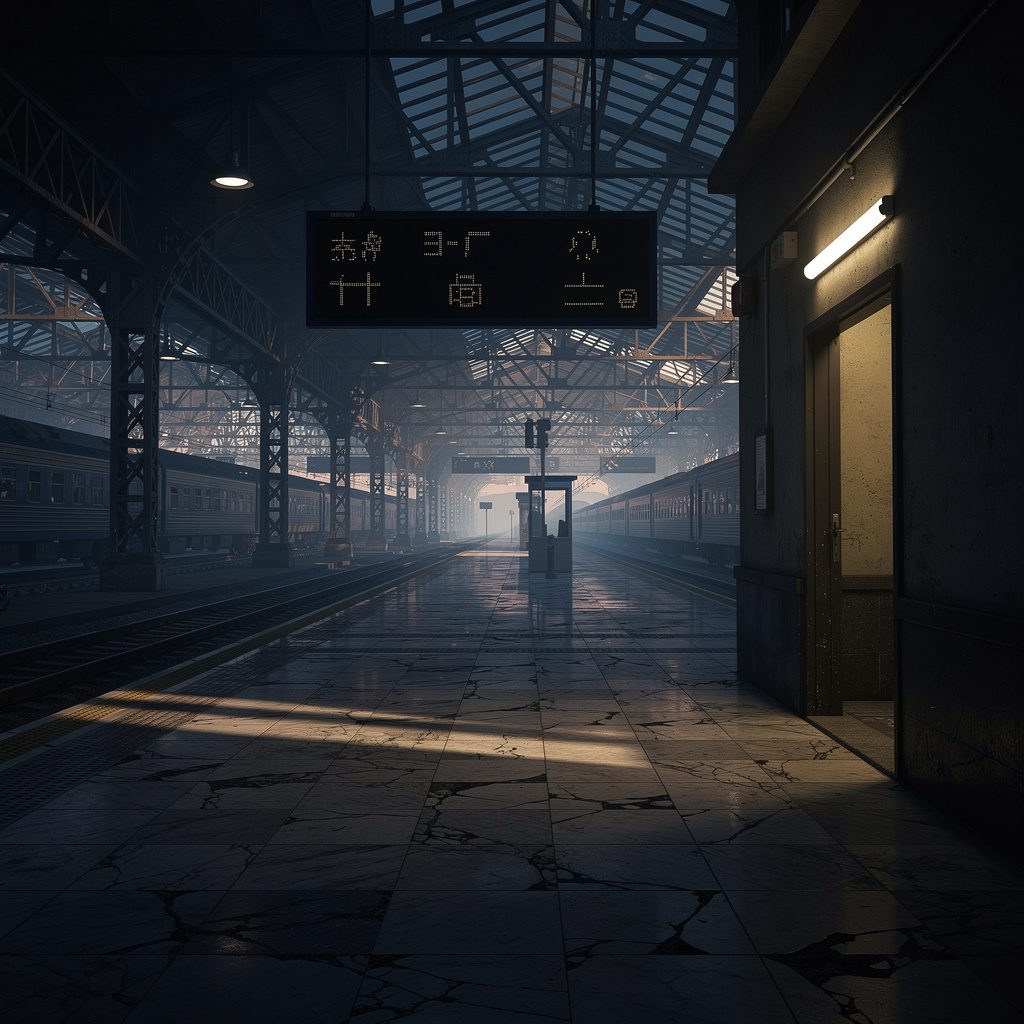
The smell of burnt copper reached Maren Odegaard before anything else did.
She noticed it standing at the information kiosk inside Milwaukee’s central rail terminal, the kind of industrial building that had once been grand and now smelled mostly of floor wax and old ambition. The burnt-copper smell was faint, almost sweet, the kind of thing you dismiss as a trick of ventilation. She dismissed it. She had a 6:42 to Chicago and a deposition to prepare, and the kiosk was showing a departure board that had stopped updating forty-seven minutes ago.
That was the first strange thing.
The board still read 5:55 in the corner timestamp. It had been 6:02 when Maren walked in. She checked her phone: 6:03 now. She looked around for a terminal employee, found none, and crossed the main hall toward the ticketing window.
The man at the window was named Gregor Schuh, though Maren would never learn this. He was sixty-one, had worked this counter for nineteen years, and was staring at his own screen with the particular stillness of someone who has just seen something that doesn’t make sense. His screen showed a maintenance override — not unusual in itself — but the override had been triggered remotely, from an IP address the system flagged as internal, and it had done one specific thing: locked the departure countdown for every train in the terminal at forty-seven minutes.
Every train. Simultaneously.
“Excuse me,” Maren said.
Gregor looked up. He had kind eyes and a neatly trimmed beard going gray at the edges, and for a moment he looked at her with the expression of a man who very much wanted to tell someone something and was trying to figure out whether he should.
“Is the board broken?” she asked.
“We’re looking into a technical issue,” he said. Careful. Practiced. The words of a man following a protocol he hadn’t written.
Maren leaned forward slightly. She was a federal public defender. She had spent eleven years watching people say one thing while their bodies said another. Gregor Schuh’s hands were flat on the counter, fingers slightly spread, the posture of someone bracing.
“Is there a safety issue?” she said, quiet enough that the man behind her in line couldn’t hear.
Gregor held her gaze for exactly one second too long. “Your train is on time,” he said. “Platform four.”
She walked away, but she didn’t go to platform four.
Instead she found a bench near the east corridor, sat down with her briefcase across her knees, and took out her phone. She pulled up the terminal’s public Wi-Fi — a habit from years of working in courthouses with bad signal — and noticed something that made the back of her neck tighten. The network was named what it always was, MKE_RAIL_GUEST, but it was broadcasting from two access points simultaneously where there should only be one. A duplicate. Someone had planted a rogue node.
She was not an IT specialist. But she had worked a case two years ago involving a man who had used a rogue Wi-Fi node in a federal building to intercept communications between attorneys and clients. She knew what it meant. Someone in this terminal was watching traffic. Collecting data. And they had frozen the departure boards at the same moment they switched the node on.
Forty-seven minutes.
She stood up.
The terminal was busy — a Tuesday evening crowd, commuters and travelers and a school group from somewhere wearing matching yellow lanyards. The noise was ordinary. The lights were ordinary. And yet the burnt-copper smell was back, stronger now, coming from the direction of the service corridor that ran behind the ticketing counters.
Maren walked toward it.
The corridor door was propped open with a rubber wedge — the kind of casual, invisible detail that suggests someone who belongs there and is coming right back. Inside, the corridor was narrow and fluorescent-lit, lined with grey utility panels. Maren went in. She told herself she would stop if she heard anything alarming. She told herself she was being paranoid. She went in anyway.
Halfway down the corridor she found a man crouched next to an open panel.

 WhatsApp
 Telegram
 Email







Categories
- AI & Technology
- Contemporary
- Corporate Control
- Creepypasta
- Crime Thriller
- Cyberpunk
- Dark Fantasy
- Enemies to Lovers
- Fairy Tale Retelling
- Fantasy
- First Contact
- Forbidden
- Genetic/Body Horror
- High Fantasy
- Monster Hunter
- Mythic/Folklore
- Paranormal
- Portal/Otherworld
- Post-Apo
- Post-Collapse Society
- Psychological Thriller
- Romances
- SCI-FI
- Second Chance
- Slow Burn
- Space Combat
- Spacepunk
- Surveillance State
- Survival Thriller
- Thrillers
- Time Travel
- Treasure Hunter
- Urban Fantasy
- Witchcraft/Curses
Tags
10min stories atmospheric atmospheric fantasy atmospheric fiction contemporary romance Creepy creepypasta crime thriller dark fantasy debt dystopia emotional fiction enemies to lovers ensemble cast epistolary fantasy first person folklore forbidden romance framed narrative high fantasy love story magic Memory mystery Paranormal psychological horror psychological thriller romance sci-fi second chance second chance romance short fiction short story slow burn space station speculative fiction supernatural Survival survival thriller suspense thriller travel romance witchcraft workplace romance
Leave a Reply