TRANSCRIPT — WKND 88.3 FM, Night Broadcast Log
Date: November 14
Logged by: Engineer on duty, A. Ferris
Note attached to tape reel, handwritten:
“Something wrong with the 2 a.m. slot. Caller ID shows no incoming line but the board registers a voice. I replayed the recording three times. You can’t hear it on playback. I could only hear it live. Attaching this note in case anyone else notices. In case I’m not here to explain.”
The note was unsigned after the initials. The tape reel was logged, shelved, and forgotten for eleven days.
—
He had been watching Swati for six days before he understood why he couldn’t stop.
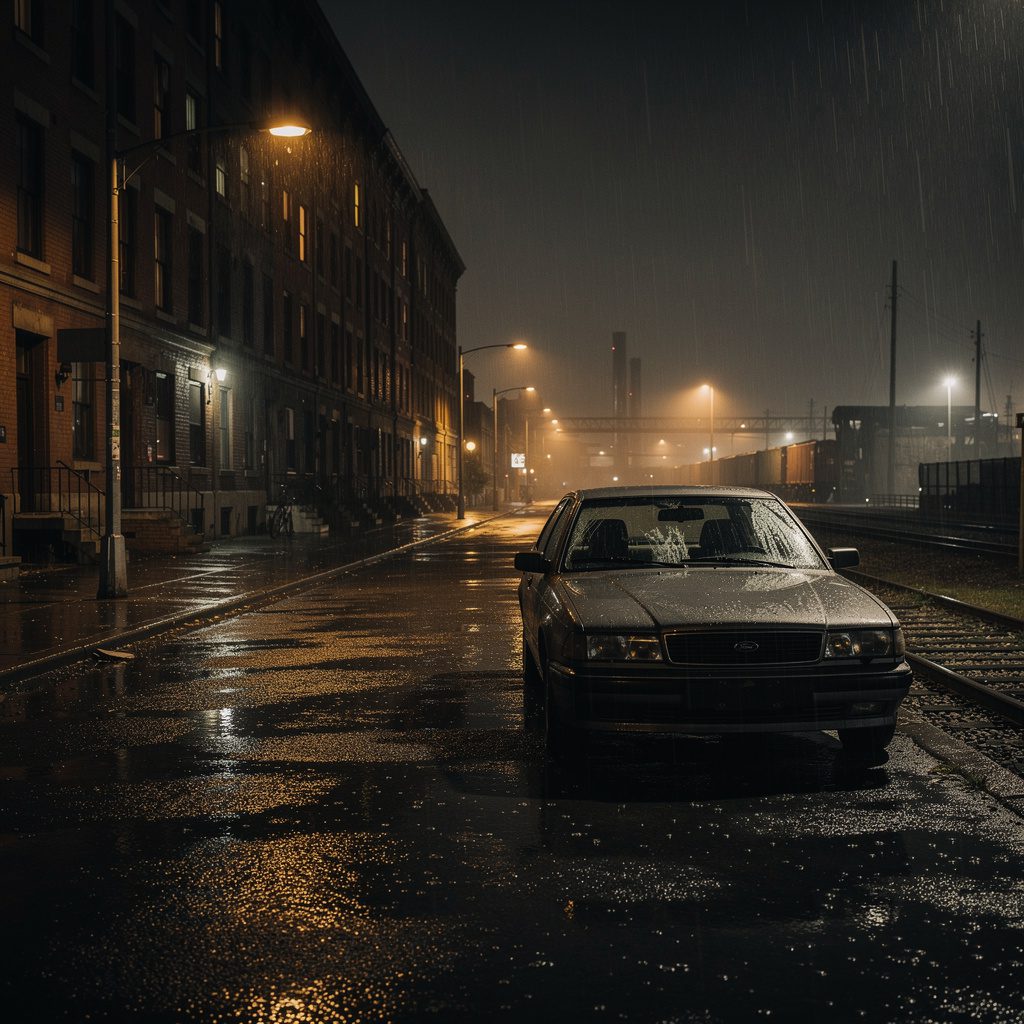
He told himself it was professional. He was parked on Dalton Street most evenings, a few houses down from the row of converted brownstones near the old rail yard in Pittsburgh’s Strip District. The neighborhood smelled of river water and cold iron, and the sodium lights turned everything a shade of amber that made the whole block look like an old photograph. He had a thermos of coffee and a notebook he rarely wrote in. He told himself he was waiting for someone else entirely.
But it was always Swati he watched.
She came home from her shift at the hospital around eleven, still in her scrubs under an unzipped jacket, carrying a reusable bag that probably held dinner she wouldn’t eat until midnight. She was methodical in small ways he had catalogued without meaning to: she checked her mailbox twice, she paused at the top of her stoop for exactly one breath before unlocking the door, and once inside, the light in her front room came on within thirty seconds. He knew the layout of her habits the way you know a song you’ve heard too many times.
What he didn’t know was what she did between two and three in the morning, when the front room light went off and a faint blue glow appeared in the window at the far end of the hall.
It looked like a television. But it pulsed wrong.
—
Swati had found the radio at an estate sale in Lawrenceville three weeks earlier. It was a 1970s console model, teak veneer, the kind that weighed as much as a small dog. She’d bought it because it matched the reading chair she’d inherited from her grandmother, and because there was something about analog dials that felt honest in a way her phone never did.
The voice started on the fourth night.
She had it tuned to a jazz station out of Oberlin when the music faded mid-song, not the way songs fade, but the way a room goes quiet when something enters it. Then a voice, low and unhurried, began to speak. It was not on the broadcast. She knew this because she pressed her ear to the speaker and the voice was perfectly clear, perfectly intimate, as though it originated inside the wood itself.
It said her name.
Not “Swati” as a greeting or an announcement. It said it the way someone says a name when they have been holding it a long time and finally have permission to let it go.
She turned the radio off. Sat in the dark for ten minutes. Turned it back on. Jazz, uninterrupted. She went to bed and told herself she was exhausted, which was true, and that exhaustion explains most things, which she was no longer certain was true.
By the second week, she had stopped turning it off.
—
The man in the parked car on Dalton Street—whose name was Nikos, though he had told no one his name in several days—had his own radio. It was the car’s original stereo, factory-installed, nothing unusual. He kept it off. He had kept it off since the night three weeks ago when, driving back from a job that had not gone as planned, a voice had come through the static between stations and told him to go to Pittsburgh. Told him to find a woman in scrubs near the old rail yard.
He was not a man who followed instructions from radios. He understood that. He had said so, out loud, to the empty car, and then he had driven north anyway because the alternative was continuing in the direction he had been going, and he was no longer sure that direction led anywhere he wanted to arrive.

 WhatsApp
 Telegram
 Email







Categories
- AI & Technology
- Contemporary
- Corporate Control
- Creepypasta
- Crime Thriller
- Cyberpunk
- Dark Fantasy
- Enemies to Lovers
- Fairy Tale Retelling
- Fantasy
- First Contact
- Forbidden
- Genetic/Body Horror
- High Fantasy
- Monster Hunter
- Mythic/Folklore
- Paranormal
- Portal/Otherworld
- Post-Apo
- Post-Collapse Society
- Psychological Thriller
- Romances
- SCI-FI
- Second Chance
- Slow Burn
- Space Combat
- Spacepunk
- Surveillance State
- Survival Thriller
- Thrillers
- Time Travel
- Treasure Hunter
- Urban Fantasy
- Witchcraft/Curses
Tags
10min stories atmospheric atmospheric fantasy atmospheric fiction contemporary romance Creepy creepypasta crime thriller dark fantasy debt dystopia emotional fiction enemies to lovers ensemble cast epistolary fantasy female protagonist first person forbidden romance framed narrative high fantasy love story magic Memory mystery Paranormal psychological horror psychological thriller romance sci-fi second chance second chance romance short fiction short story slow burn space station speculative fiction supernatural Survival survival thriller suspense thriller travel romance witchcraft workplace romance
Leave a Reply