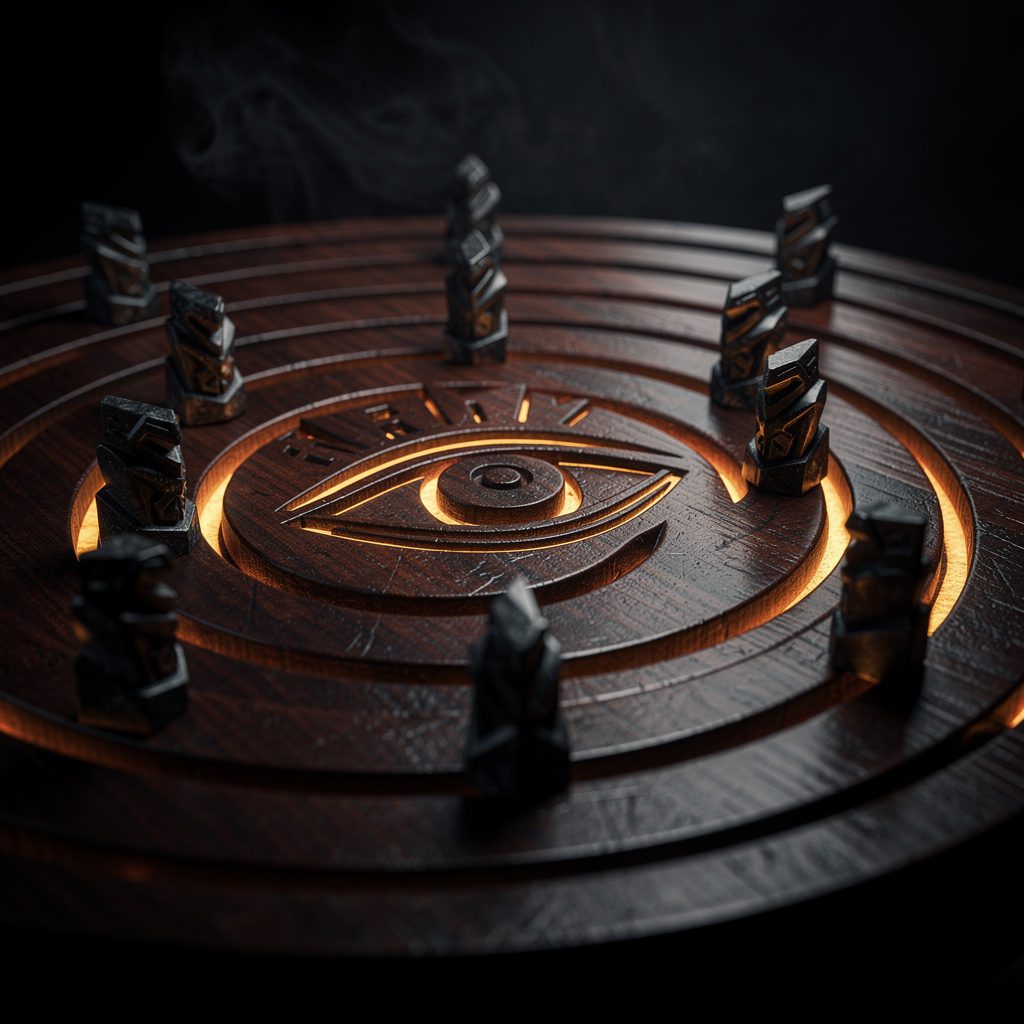
The board game arrived without a return address, and the moment Nora touched the box, every clock in her apartment stopped. She told herself it was a coincidence. She was wrong.
It was a Tuesday night in late October, the kind of night that feels thinner than usual, like the air itself is listening. Nora had ordered nothing online. She had no family nearby to send gifts. Yet there it sat on her doorstep — a flat rectangular box wrapped in brown paper, her name written in ink that seemed to shift between black and deep violet depending on the angle of the light.
She almost left it outside. Almost.
The game inside was unlike anything she had seen before. The board was made of something that looked like dark wood but felt warm to the touch, almost like skin. The pieces were small obsidian figures, each one carved into a different posture — some standing, some kneeling, one with its hands raised as if surrendering. There were no instructions. There was only a single card tucked beneath the board that read: YOU ALREADY KNOW HOW TO PLAY.
Nora laughed at that. A short, nervous sound that died quickly in the silence of her apartment.
She set the board on her coffee table and studied it. The grid was unusual — not a standard square layout but an asymmetrical spiral that curved inward toward a central space marked with a symbol she didn’t recognize. It looked old, like something between a compass rose and an eye.
Her phone buzzed. A message from an unknown number: YOUR TURN.
She stared at the screen. Then she looked at the board. One of the obsidian figures had moved. She was certain it had been in the corner of the board when she set it down. Now it stood two spaces closer to the center.
Nora told herself she had simply misremembered its position. She placed one of the other figures on the board, choosing a space near the edge almost at random. It felt right, the way a word sometimes feels right before you understand why.
She went to bed telling herself it was an art piece, a novelty, something a street vendor had left at the wrong address.
She dreamed of a room with no doors and a voice that counted backward from ten.
In the morning, three more figures had moved. All of them closer to the center.
Nora photographed the board before she left for work, comparing the image to her memory of the night before. The pieces had definitely moved. The standing figure was now only one space from the central symbol. She felt a cold pressure behind her eyes, the kind that comes before a migraine or a revelation.
At work she researched the symbol from the center of the board. It took her most of the afternoon to find a partial match — a woodcut from a 17th-century manuscript about folk games played in isolated mountain villages in Central Europe. The text was in archaic German, but a rough translation described something called Das letzte Feld, which meant The Last Square. According to the manuscript, the game was played between a living person and something that was not.
The loser, the text said, did not simply lose the game.
Nora closed her laptop.
She went home faster than usual, taking the lit streets, avoiding the underpass she normally used. When she opened her apartment door, the board was glowing faintly. Not with any visible light source — it was more like the wood itself had become slightly luminous, the way deep water sometimes catches light that has no clear origin.
The standing figure was now on the central square.
Her phone buzzed again. The unknown number: FINAL MOVE. YOURS.
Nora stood very still in the doorway. The room felt pressurized, as if the walls had shifted two inches inward while she was gone. The air smelled faintly of rain and something older — stone, maybe, or cold earth.
She understood now that the game had rules, even if they were never written down. She had made a move the first night without knowing it. The other player had been responding ever since. And now it was her turn, and whatever space she chose would end things one way or another.

 WhatsApp
 Telegram
 Email







Categories
- AI & Technology
- Contemporary
- Corporate Control
- Creepypasta
- Crime Thriller
- Cyberpunk
- Dark Fantasy
- Enemies to Lovers
- Fairy Tale Retelling
- Fantasy
- First Contact
- Forbidden
- Genetic/Body Horror
- High Fantasy
- Monster Hunter
- Mythic/Folklore
- Paranormal
- Portal/Otherworld
- Post-Apo
- Post-Collapse Society
- Psychological Thriller
- Romances
- SCI-FI
- Second Chance
- Slow Burn
- Space Combat
- Spacepunk
- Surveillance State
- Survival Thriller
- Thrillers
- Time Travel
- Treasure Hunter
- Urban Fantasy
- Witchcraft/Curses
Tags
10min stories atmospheric atmospheric fantasy atmospheric fiction contemporary romance Creepy creepypasta crime thriller dark fantasy debt dystopia emotional fiction enemies to lovers ensemble cast epistolary fantasy female protagonist first person forbidden romance framed narrative high fantasy love story magic Memory mystery Paranormal psychological horror psychological thriller romance sci-fi second chance second chance romance short fiction short story slow burn space station speculative fiction supernatural Survival survival thriller suspense thriller travel romance witchcraft workplace romance
Leave a Reply