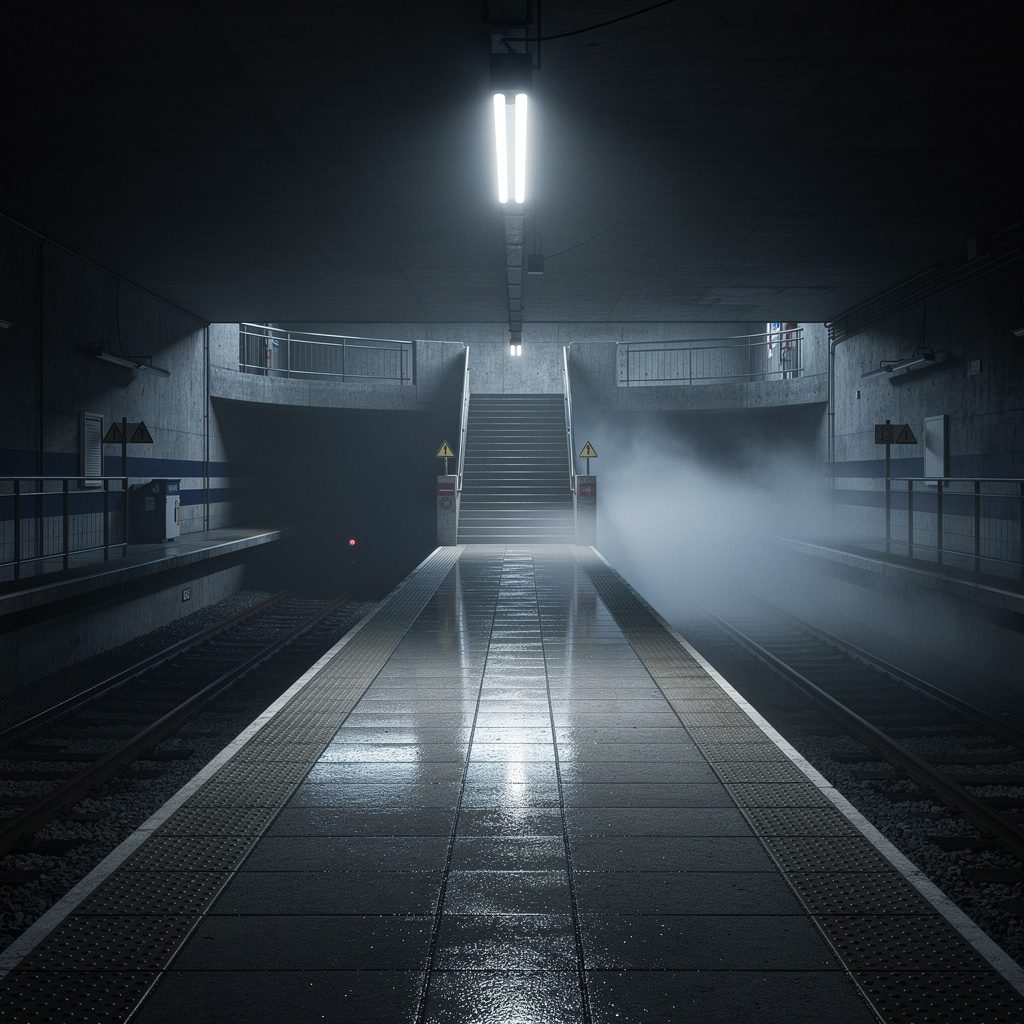
Four minutes.
That was how long Priya Subramaniam had before the last southbound train left Millhaven Station, and she was already certain they were not going to make it.
She pressed her back against the cold tile of the station wall and looked at the other three. Dex, who had gone very still in the way that large men sometimes do when fear overrides their instinct to move. Krystyna, whose fingers were wrapped so tightly around her phone that the screen had cracked under her thumb. And Wei, standing slightly apart from the group at the edge of the platform, staring back down the long tunnel of the entrance corridor as though he expected something to walk through it.
They had met the stranger forty minutes ago. Now they could not agree on what he had been.
The station sat on the outer edge of Portland, Oregon, one of those transit hubs that the city had built with ambition and then slowly forgotten — high ceilings stained by decades of rain-damp, vending machines long since emptied, a single flickering fluorescent tube above the southbound platform. At this hour, on a Tuesday, there were no other passengers. There was only the four of them, and the memory of the man who had known things he could not possibly have known.
It had started at the coffee kiosk on the upper level. Dex had been first. He’d been standing in line, scrolling through messages on his phone, when the man appeared beside him — slight, maybe sixty, wearing a gray coat that was one size too large. He had the look of someone who had been traveling for a very long time and had stopped expecting to arrive anywhere.
“Your mother’s name was Adaeze,” the man said. Not a question. Flat and certain, the way you say the name of someone you knew well.
Dex had gone cold. His mother had died eleven years ago. He had never posted her name online, never mentioned it in any group they’d joined, never used it as anything that could be scraped or searched. He had stared at the man and the man had stared back with eyes that were not unkind but were somehow very distant, as if he were watching Dex from the far end of a long room.
“She wants you to stop carrying the photograph in your left pocket,” the man continued. “She says it’s already done what it needed to do.”
The photograph had been there. A worn square of it, folded twice, that Dex had not shown anyone in years.
He had grabbed Krystyna immediately. Krystyna, who was practical, who studied epidemiology at Portland State and believed firmly in things that could be measured. She had walked over to the man with the expression she wore when preparing to disprove something. He had turned to her before she reached him.
“You changed your dissertation topic in March,” he said, “because of what happened in Wroclaw. You still haven’t told anyone what happened in Wroclaw.”
Krystyna had not spoken for nearly a minute after that. What had happened in Wroclaw was something she had locked so thoroughly inside herself that she sometimes doubted the reality of it. She had never written it down. She had not told her therapist. It existed only in her own memory, in the city she had left at twenty-two and never returned to.
She had gone to find Priya and Wei.
Priya had been skeptical until the man turned to her. He said nothing dramatic, nothing that could be written off as a cold-reading trick. He simply told her the name of the street she had grown up on in Chennai, then the name of the boy who had lived three houses down, then what that boy had said to her on the last afternoon she had ever seen him. His exact words. Priya felt the ground shift beneath her in a way that had nothing to do with her feet.
Wei had not waited for his turn. He had taken one look at the man’s face from across the kiosk and said, very quietly, “I know what you are.”
And the man had smiled — not warmly, but with something like recognition — and said, “No. But you’re closer than the others.”
That was when they had run.
Now, three minutes and forty seconds before the train, they stood on the platform in the particular silence that falls when four people are each privately revising what they believe is possible.
“He’s still up there,” Wei said, without turning around. He was watching the corridor entrance in the way that people watch the edge of a forest at night, not because they have seen something but because they feel the possibility of it.
“How do you know?” Priya asked.
“Because I can feel it.” He paused. “The same way I felt it in Chengdu. I was twelve. Something came close and then stopped. Like it was deciding.”
Dex looked at him sharply. “You never mentioned Chengdu.”
“You never asked about the things I don’t mention.”
Krystyna pulled her coat tighter. Her phone screen, cracked as it was, showed no signal. It had shown no signal since they’d come down to the platform, which was not unusual here, except that it had shown full bars on the upper level right up until the moment they’d descended the stairs. She had checked twice. She checked a third time now. Nothing.
“If it’s paranormal,” she said, and the word felt strange in her mouth, clinical and insufficient at once, “then running doesn’t do anything. You can’t outrun something that already knows everything about you.”
“Maybe it’s not about outrunning it,” Priya said. Her voice was steady but her hands were not. “Maybe it’s about not being alone when it reaches you.”
The fluorescent light above them stuttered. In the half-second of darkness, they all heard the same thing: footsteps on the stairs. Not hurried. Patient.
Dex turned to face the corridor entrance. The others turned with him. There was a shape at the top of the stairs, in the place where the corridor light ended and the platform shadows began. It was still, and they were still, and for a moment the station held its breath.
Two minutes.
The shape began to descend.
“Don’t look at his eyes,” Wei said suddenly.
“Why?” Krystyna demanded.
“Because in Chengdu, looking was how it got inside. I don’t know what inside means. I just know I didn’t look, and whatever it was, it moved on.”
The footsteps were slow on the stairs. Deliberate. The man — if it was the same man, and something in each of them felt certain that it was — made no sound beyond the footsteps. No breathing that they could hear. No shift of fabric.
Priya’s mind, operating with the analytical precision that stress sometimes unlocks, moved through what she knew. He had told her things that were inaccessible. Not guessable, not inferable from social media or public records or any reasonable chain of deduction. He had told her the words spoken on a specific afternoon in a city she had left at age nine, words exchanged between two children on a quiet street in Chennai. There was no mechanism. There was no explanation that fit inside the world she had built for herself.
And yet here was the man, step by step, descending toward them.
“If the train doesn’t come,” Dex said quietly, “we go up the other stairs. The maintenance exit on the north end.”
“And if he follows?”
“Then we keep going.”
Krystyna was watching the floor. Not out of fear — or not only out of fear — but because Wei’s instruction had landed in her with the weight of something true. She did not fully understand why she was obeying it. She was a scientist. She did not take instruction from instinct. And yet her eyes were fixed on the concrete platform, and she found she did not want to raise them.
One minute.
The man reached the bottom of the stairs. He stopped at the edge of the platform, maybe thirty feet from where they stood. The group held their cluster, shoulders almost touching, four people reduced to a single frightened shape by proximity and shared dread.
The man spoke. His voice carried easily in the empty station, calm and unhurried, as though they were resuming a conversation.
“You don’t need to be afraid,” he said. “I’m not here to take anything.”
“Then what are you here for?” Priya asked. She had not planned to speak. The question came out of her anyway.
He was quiet for a moment. In the fluorescent half-light, his face was composed and ageless in a way that was difficult to look at directly, not because it was grotesque but because it was wrong in a way that resisted definition, like a photograph where the perspective is slightly off.
“To make sure you know,” he said, “that what you’ve each been carrying — you don’t have to carry it alone anymore. Someone already knows. Someone already knew.”
The train arrived.
It came with the rush of compressed air and the shriek of brakes that filled the station like a physical thing, the light of it flooding the platform, and in the noise and brightness the four of them moved — not running, but moving quickly, purposefully, stepping into the nearest car as the doors opened. Dex went first, then Krystyna, then Priya. Wei was last. He paused at the door and looked back.
The platform was empty.
The man was gone. Not retreated up the stairs, not stepped back into shadow. Simply gone, in the way that something is gone when it was never quite fully present to begin with.
Wei stepped onto the train. The doors closed behind him.
The four of them sat in a row in the empty car as Portland’s outer neighborhoods slid past the windows, the city’s nighttime shapes dissolving into distance. Nobody spoke for a long time. The train rocked gently on the track. Krystyna stared at her phone, which now showed full signal again, as though the dead zone had been specific to that platform and nothing else.
Dex reached into his left pocket. His fingers found the photograph. He held it for a moment, not taking it out, just feeling the familiar worn edges of it.
Then, slowly, he moved it to his right pocket instead.
He couldn’t have explained why. It felt like the only thing to do.
Priya was watching the window. In the glass, she could see the faint reflection of the car behind them — empty seats, empty aisle. She watched it for a long time, because she could not fully shake the feeling that the reflection was slightly delayed, that it showed the car not as it was but as it had been a second ago, and that in the version a second ago there had been a fifth figure seated quietly at the far end.
She told herself it was the glass. The angle. The way moving light plays tricks.
She kept watching anyway.

 WhatsApp
 Telegram
 Email







Leave a Reply