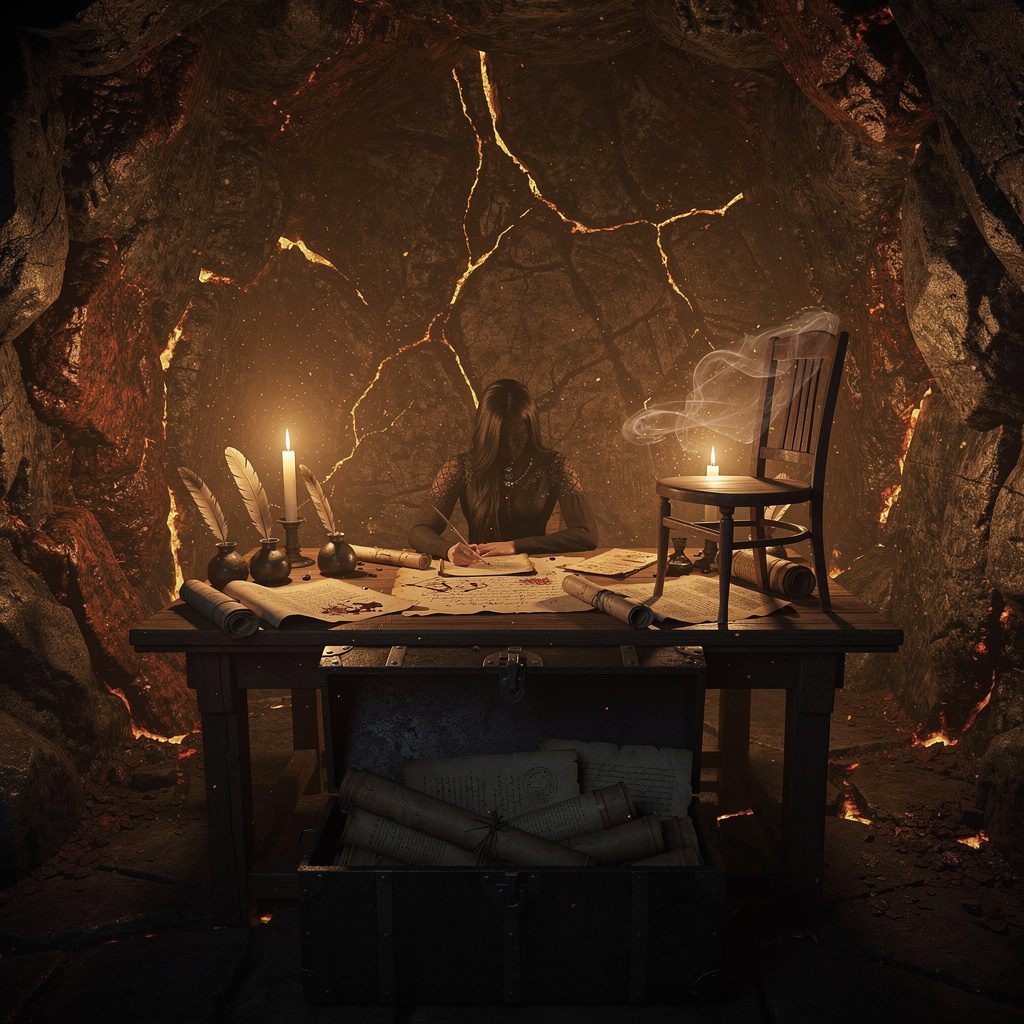
“You haven’t told anyone how it ends,” the stranger says, and Araceli’s hand stops moving above the ink pot. She has not invited this woman in. The door to the scriptorium was latched — she is certain of it — and yet here she sits, across the narrow writing table, in the chair that belongs to no one because Araceli has never permitted anyone to sit in it. The stranger is watching her with eyes the color of river silt after a flood, pale grey-brown and utterly still, and there is something about the quality of her stillness that does not feel like patience. It feels like waiting. Like a trap already sprung, now simply closing.
Araceli sets the quill down. The scriptorium is a long, low room carved into the belly of the Caldera Walls — the ancient volcanic rock of the city of Ossivane, which has been inhabited for so long that no one remembers what it was called before the first settlers pressed their handprints into the stone and called it home. The walls here are warm to the touch even in winter, heated from somewhere deep below, and the room smells of old parchment and iron-gall ink and the faint mineral tang of sulfur that seeps through the rock no matter how many times the building wardens seal the cracks. It is a good room for secrets. Araceli has kept many of them here, pressed flat between pages, locked inside stories she writes for no one — stories she has never read aloud, never copied for a patron, never sold to the city’s tale-brokers who deal in fictions the way other merchants deal in grain. She writes them because something inside her demands it, the way lungs demand air, and she finishes them and puts them away in the iron chest beneath her worktable and does not speak of them. Not to her apprentice. Not to the women she drinks with on the long evenings of the dry season. Not to anyone, ever, in all the twelve years she has kept this room.
“I don’t know what you mean,” Araceli says, and hears exactly how unconvincing she sounds.
The stranger smiles. It is not a warm smile. It is the smile of someone who expected that precise response, who has perhaps heard it a hundred times before, from a hundred different people in a hundred different rooms. She is dressed in traveling clothes that show no dust, no road-wear, no sign of the journey that should have brought her to Ossivane — the city sits at the end of a three-day climb through the Ashmarrow Pass, and everyone who arrives here arrives worn, thirsty, and smelling of the Pass’s strange alkaline winds. This woman smells of nothing at all. Her hair is black and very straight, pulled back from a face that is difficult to age — she might be forty, she might be seventy, she might be something else entirely that simply wears the shape of a woman as a convenience. Her hands, resting flat on the table, are ordinary hands, and Araceli finds herself staring at them the way one stares at a calm sea when one knows a storm is underneath it. “The girl in your story,” the stranger says, conversationally, as if they are resuming a discussion Araceli began. “The one who trades her reflection to the well-spirit in exchange for her sister’s life. You haven’t decided yet whether the sister deserves it. That’s why you’ve written the ending three times and burned all three drafts.”
Araceli does not breathe for a moment. The story exists in no written form — she burned the drafts herself, in the small iron brazier in the corner, and scattered the ash. The story exists only inside her own skull, in the particular way that unfinished things live there, half-formed and restless. Nobody could know it. Nobody could know the specific weight of her uncertainty about the sister, the way she has sat for six months with that moral question like a stone in her boot, unable to write through it because she cannot resolve it honestly. And yet.
“Who are you?” she asks.
“Someone who has read a great many endings,” the stranger says. “My name is Xinyi. That is all you need.”

 WhatsApp
 Telegram
 Email






Categories
- AI & Technology
- Contemporary
- Corporate Control
- Creepypasta
- Crime Thriller
- Cyberpunk
- Dark Fantasy
- Enemies to Lovers
- Fairy Tale Retelling
- Fantasy
- First Contact
- Forbidden
- Genetic/Body Horror
- High Fantasy
- Monster Hunter
- Mythic/Folklore
- Paranormal
- Portal/Otherworld
- Post-Apo
- Post-Collapse Society
- Psychological Thriller
- Romances
- SCI-FI
- Second Chance
- Slow Burn
- Space Combat
- Spacepunk
- Surveillance State
- Survival Thriller
- Thrillers
- Time Travel
- Treasure Hunter
- Urban Fantasy
- Witchcraft/Curses
Tags
10min stories atmospheric atmospheric fantasy atmospheric fiction contemporary romance Creepy creepypasta crime thriller dark fantasy debt dystopia emotional fiction enemies to lovers ensemble cast epistolary fantasy female protagonist first person forbidden romance framed narrative high fantasy love story magic Memory mystery Paranormal psychological horror psychological thriller romance sci-fi second chance second chance romance short fiction short story slow burn space station speculative fiction supernatural Survival survival thriller suspense thriller travel romance witchcraft workplace romance
Leave a Reply