The message was already there when Kaja unlocked her phone.
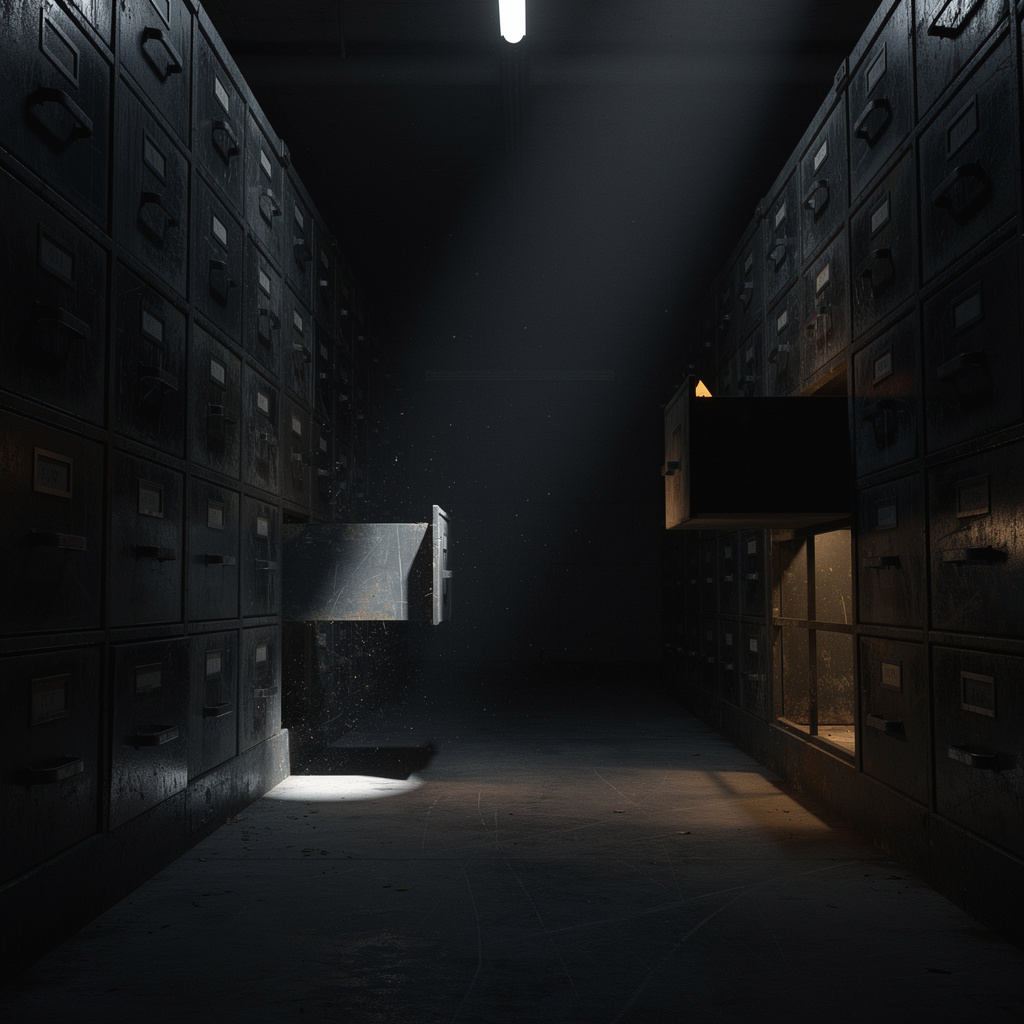
That was the thing that made no sense. That was the thing she kept coming back to, even now, crouched behind the rusted filing cabinet in the basement archive of the Oslo city records building, listening to footsteps move through the floor above her head.
The message had arrived at 11:47 PM on a Tuesday. She had read it at 11:52. She had not written it until 11:59.
She remembered the exact order of events because she had been meticulous about it afterward, the way you are meticulous about something that has unraveled your understanding of how time works.
The footsteps paused.
Kaja pressed her back harder against the cold metal. The archive smelled of dust and old paper and something underneath those things — something faintly sweet, almost floral, which did not belong in a basement full of municipal records.
She had noticed the smell earlier too. Before she had understood what was happening.
Before Spyros.
—
He had found her three weeks ago through a mutual contact — a researcher at the University of Bergen who moved in the same obscure circles as Kaja: people interested in anomalous data, in events that did not fit neatly into known frameworks.
Spyros Pappas was Greek, mid-forties, with the kind of stillness that some people mistake for calm and others recognize as watchfulness. He had sent her a carefully worded email about a pattern he had noticed in telecommunications logs — messages flagged by automated systems as arriving before their metadata timestamp showed them being composed.
Not by minutes. By hours, sometimes. By days.
Kaja had been skeptical. She was a digital archivist by training, and she knew how easily timestamp errors occurred, how poorly synchronized clocks could create the appearance of paradox where there was only bureaucratic sloppiness.
But she had looked at the logs he sent her.
And the logs were clean.
—
The footsteps above her moved again. Slow, deliberate. Moving toward the stairwell.
Kaja did not breathe.
She thought about the message on her phone. The one she had received before she had written it. The one that read, in her own words, in her own particular shorthand: “Building archive. Lower level. Don’t use the main door.”
She had written those exact words — that exact phrasing — to Spyros at 11:59 PM, after he had called her in a panic saying someone had been through his apartment, that files were missing, that they needed to meet somewhere off the usual grid.
But the message had been sitting in her received folder since 11:47.
Sent from her own number.
To her own number.
She had not told Spyros about that part yet. She was not sure why.
—
The stairwell door opened with a sound like a slow exhale.
Light swept across the ceiling of the archive — a narrow flashlight beam, not the building’s overheads. Someone who did not want to announce themselves through the windows.
Kaja made herself very small behind the cabinet. She was good at that. She had always been good at making herself invisible in spaces — a skill she had never examined too closely, never asked herself where it came from.
The beam moved along the rows of shelving.
She thought about Spyros. About the way he had looked when they’d finally met in person two weeks ago, over coffee in a Frogner café. He had seemed genuinely frightened, which was disarming, because he did not seem like a man who frightened easily. He had laid out his research with precision. Eleven cases, spanning eight countries, over a period of six years. All of them involving messages received before transmission. All of them connected — tenuously, but connected — to individuals who had later reported what he carefully called “cognitive discontinuity.”
Memory gaps. Lost hours. A sense of being slightly behind one’s own actions, as though the body were moving half a second ahead of the mind.
Kaja had listened. She had asked good questions. She had not mentioned that she had been experiencing exactly that for the past four months.
She had not mentioned the gaps.
—
The flashlight beam stopped.
It was pointing directly at the cabinet she was hiding behind.
Kaja’s heart went absolutely still.
Then a voice said, quietly: “I know you’re there.”
Spyros.
She exhaled. Stood up slowly. Her knees ached from the cold concrete.
“You’re late,” she said.

 WhatsApp
 Telegram
 Email







Categories
- AI & Technology
- Contemporary
- Corporate Control
- Creepypasta
- Crime Thriller
- Cyberpunk
- Dark Fantasy
- Enemies to Lovers
- Fairy Tale Retelling
- Fantasy
- First Contact
- Forbidden
- Genetic/Body Horror
- High Fantasy
- Monster Hunter
- Mythic/Folklore
- Paranormal
- Portal/Otherworld
- Post-Apo
- Post-Collapse Society
- Psychological Thriller
- Romances
- SCI-FI
- Second Chance
- Slow Burn
- Space Combat
- Spacepunk
- Surveillance State
- Survival Thriller
- Thrillers
- Time Travel
- Treasure Hunter
- Urban Fantasy
- Witchcraft/Curses
Tags
10min stories atmospheric atmospheric fantasy atmospheric fiction contemporary romance Creepy creepypasta crime thriller dark fantasy debt dystopia emotional fiction enemies to lovers ensemble cast epistolary fantasy female protagonist first person forbidden romance framed narrative high fantasy love story magic Memory mystery Paranormal psychological horror psychological thriller romance sci-fi second chance second chance romance short fiction short story slow burn space station speculative fiction supernatural Survival survival thriller suspense thriller travel romance witchcraft workplace romance
Leave a Reply