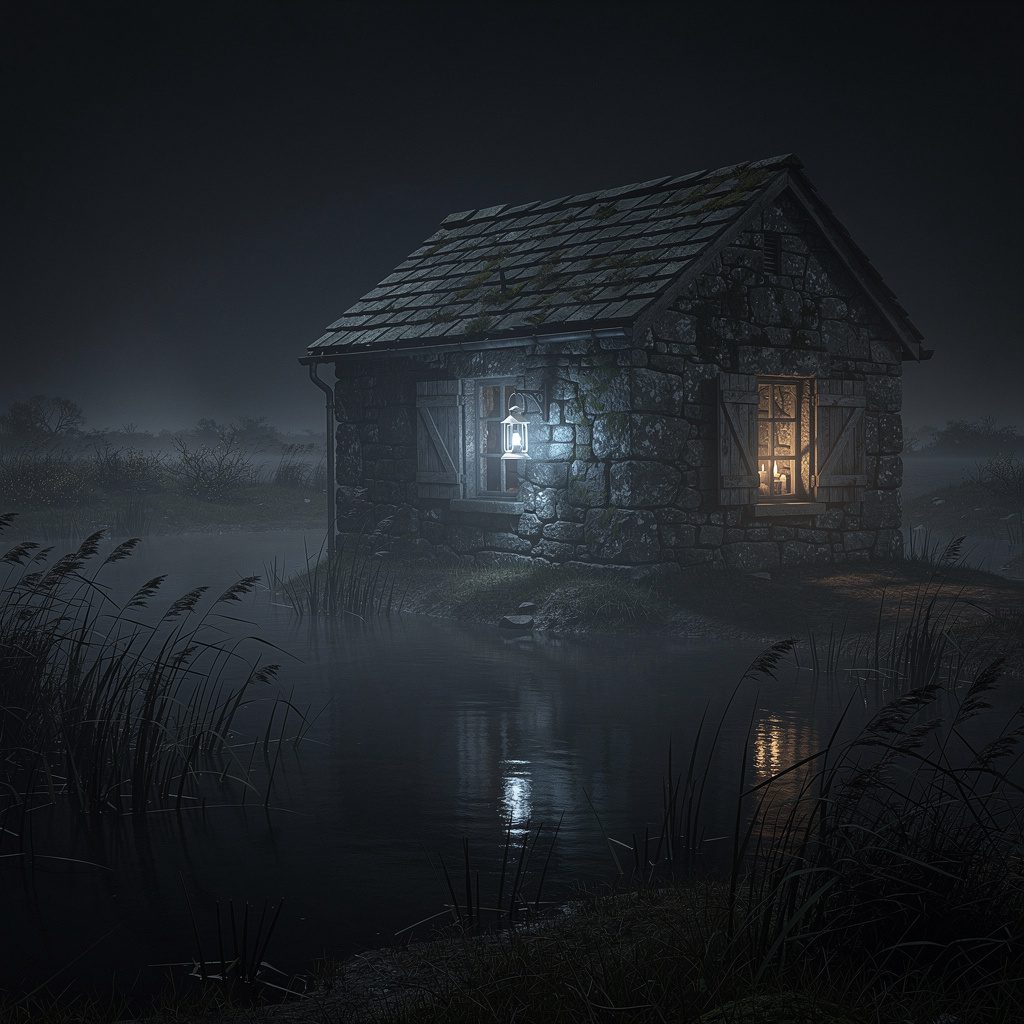
The lantern has been burning for eleven years.
I know this because Fiona told me so on the first night I joined the vigil, her voice as steady as the flame itself. She handed me a tin cup of bitter tea, nodded toward the low stool beside the hearth, and said it the way you might say the roof needs patching — a fact, not a warning. I should have listened more carefully to the space between her words.
The four of us keep the lantern in the old waystation at the edge of Duncarrow Moss, where the peat bogs stretch out like a dark, breathing skin beneath the mist. The station itself is a squat stone building, older than anyone in the village can account for, its walls thick enough to muffle the wind that moans across the flats every night from somewhere deep in the reeds. The lantern sits on a shelf above the door — not iron, not brass, but carved from a single piece of pale bone, its surface etched with knotwork so fine and dense that staring at it too long makes your eyes slide sideways. The flame inside is the color of old honey. It does not flicker. It does not gutter. It simply burns, patient and unwavering, as if it has never once considered going out.
We do not talk about what happens if it does.
Cornelius is the oldest among us. He has kept the vigil longer than anyone, his broad hands mapped with the calluses of a man who has spent decades tending things that need tending. He sharpens his knife every evening at the same hour, the rasp of steel on stone a kind of metronome for the night. Adaeze sits across from him most evenings, her sketchbook open on her knee, drawing the same arrangement of shadows on the far wall with the focused patience of someone solving a problem only she can see. Gareth is the youngest, barely past his first shave, and he watches the lantern the way the rest of us try not to — openly, hungrily, as though he is waiting for it to do something.
I watch Gareth.
It is a quiet life, or it feels that way at first. The moss breathes its cold, green breath through the gaps in the shutters. The peat fire settles and sighs. Cornelius scrapes his blade. Adaeze draws. Gareth watches the lantern. I watch Gareth, and I tell myself this is a reasonable division of labor.
On the fourth night, Adaeze shows me one of her drawings.
It takes me a moment to understand what I am looking at. The shadows on the wall, the ones she has been sketching each evening, do not match the configuration of objects in the room. Not quite. There are shapes in them — elongated, patient shapes — that have no corresponding source. I look up at the wall. I look back at the drawing. I hand it back without saying anything, and she nods as though I have confirmed something.
“They have been there since the second night,” she says, quietly. “I thought it was my imagination. Then I thought it was the fire.”
“And now?”
She closes the sketchbook. “Now I draw them.”
On the sixth night, Gareth asks Cornelius how the lantern came to be here.
Cornelius is quiet for a long time. The knife scrapes. The fire settles.
“A woman carried it here,” he says at last. “A long time before my time. She had been given a thing she did not ask for — a knowing, they called it. She could see the shapes that move through the moss at night. She could hear the names they use for each other, the ones that are not sounds exactly but something older. It was destroying her. Not quickly. Slowly, the way water destroys stone.”
The fire pops. Gareth does not look away from the lantern.
“The only way to put it down,” Cornelius continues, “was for someone else to agree to carry it. Not be tricked into it. Not be forced. Agree. She built the lantern to hold the knowing in place — a vessel, a delay — so that whoever carried it next would have time to understand what they were agreeing to.”
“And someone agreed?” I ask.
“Someone always agrees.” He does not say it with comfort. “Every eleven years.”
I go still.

 WhatsApp
 Telegram
 Email






Categories
- AI & Technology
- Contemporary
- Corporate Control
- Creepypasta
- Crime Thriller
- Cyberpunk
- Dark Fantasy
- Enemies to Lovers
- Fairy Tale Retelling
- Fantasy
- First Contact
- Forbidden
- Genetic/Body Horror
- High Fantasy
- Monster Hunter
- Mythic/Folklore
- Paranormal
- Portal/Otherworld
- Post-Apo
- Post-Collapse Society
- Psychological Thriller
- Romances
- SCI-FI
- Second Chance
- Slow Burn
- Space Combat
- Spacepunk
- Surveillance State
- Survival Thriller
- Thrillers
- Time Travel
- Treasure Hunter
- Urban Fantasy
- Witchcraft/Curses
Tags
10min stories atmospheric atmospheric fantasy atmospheric fiction contemporary romance Creepy creepypasta crime thriller dark fantasy debt dystopia emotional fiction enemies to lovers ensemble cast epistolary fantasy female protagonist first person forbidden romance framed narrative high fantasy love story magic Memory mystery Paranormal psychological horror psychological thriller romance sci-fi second chance second chance romance short fiction short story slow burn space station speculative fiction supernatural Survival survival thriller suspense thriller travel romance witchcraft workplace romance
Leave a Reply