“You read it,” Marlon said.
He was standing between two rows of Sangiovese with the harvest light going gold behind him, and in his hand, creased and soft from handling, was the letter. My letter. The one I had written at two in the morning in the spring and tucked into the back of the old ledger in the cellar office, where no living person was ever supposed to look.
“You were never supposed to find it,” I said.
“I know.”
The air smelled of crushed grapes and warm dust. A tractor droned somewhere far down the hill. My heart was doing something undignified against my ribs.
“Beatriz,” he said, and the way he said my name, slowly, as if testing the weight of it, made me look away at the hills instead.
That was where it was now. Here, in the vines, with the paper trembling slightly in his fingers. But it had not begun here. It had begun in March, in the rain, with a cracked leather suitcase and a man I had decided to hate before he opened his mouth.
*
I had managed Villa Aurelia’s vines for six years by the time Marlon Marshall arrived.
My aunt owned the estate. She had gone to Lisbon for her hip and left behind a short, cheerful email: *An old friend’s nephew will help with the accounts and the export paperwork. Be kind.*
I was not kind. I stood in the doorway of the farmhouse with mud on my boots and watched a tall man in a coat far too thin for Tuscany climb out of a taxi, look at the sodden hillside, and say, “Is it always this wet?”
“Only when it’s not dry,” I said.
He blinked. Then, unexpectedly, he smiled. “That’s not an answer.”
“It’s the only one you’re getting.”
I should explain that I was tired. The previous autumn had cost us a third of the crop, and I had spent the winter listening to men with clean hands explain that the estate should be sold to a hotel group. Now my aunt was sending me an accountant. An accountant, to count what we’d lost.
He was given the small room above the kitchen. He took over the long table in the office, spreading his spreadsheets like a flag of conquest. I let him know, in a hundred small ways, that I did not need him.
He let me know, in a hundred small ways, that he was not leaving.
*
“You’ve put the tannin report in the wrong folder,” I told him in April.
“There’s no wrong folder. There are only folders.”
“That is the most accountant thing anyone has ever said.”
“Thank you.”
I threw a pen at him. He caught it without looking up.
It was always like that. I would leave coffee for myself on the windowsill and find it moved. He would leave a column of numbers, and I would find them corrected in red. We argued about the irrigation budget. We argued about whether the old stone barn was worth saving. We argued, once, for forty minutes, about the correct way to open a bottle of wine.
“You’re holding it like it owes you money,” I said.
“It might. I haven’t checked.”
I laughed. I hadn’t meant to. It slipped out of me, sudden and loud, and his whole face changed, and I turned and walked out into the rows before he could see what mine was doing.
*
Here is what I did not tell anyone. Not my aunt, not the village priest, not the dog.
He was good at it. All of it. He found a clause in our supplier contract that had been bleeding us for years. He sat up with me through a night of hail warnings, two blankets and one thermos between us, and did not once say *I told you so* about the netting I had refused to buy. He learned the names of the vines. He learned the names of my father’s old tools in the shed.
One evening in May I came into the office and found him asleep with his cheek on a stack of invoices and his glasses crooked, and something in my chest turned over like soil under a blade.
I wrote the letter that night.
It was a foolish thing. I didn’t mean to send it. I wrote it the way some people pray, to get the words out of the body and into the world where they could do no harm. I wrote that I had been unkind to him because it was safer than the alternative. That I had never met anyone who argued with me and made me feel *heard* at the same time. That when he laughed in the next room I stopped breathing to listen. That I was afraid, because the last man I had trusted with my heart had also been the one to tell me, gently, that the vineyard was a burden and I was a fool to carry it.
I signed it. Then I hid it in the back of the cellar ledger, a place I thought no one would ever open again, and went to bed with my face hot against the pillow.
*
“I wasn’t looking for it,” Marlon said now, in the rows, the late sun in his hair.
“Then how—”
“The ledger. The insurance claim for last year. I needed the old figures.” He swallowed. “It fell out. I thought it was a receipt.”
“And then you read the first line, and you should have stopped.”
“I should have,” he agreed. “I didn’t.”
Something hot and furious rose in me, a bright flare of old fear. I stepped toward him and snatched at the page, and he held it away, not cruelly, just out of reach.
“That was private!”
“I know.”
“It was the only thing I had that was *mine*, and you—” My voice cracked in the middle. I hated that. “You’ve known for three days. Three days you’ve been looking at me across the dinner table and saying nothing.”
“I was trying to work out what to say.”
“And?”
“I haven’t worked it out.”
The wind moved through the leaves, a long dry whisper. A bee wandered between us, unbothered by the wreckage of two people.
*
In June, the heat had come down on the hills like a lid. We stopped arguing in the afternoons because it took too much energy. Instead we sat on the stone wall behind the barn, sharing a bottle of cold water, saying very little.
“Why do you stay?” he asked me once. “The offers are good. You could rest.”
“My father planted the row by the cypress,” I said. “He used to say a vine is the only promise that gets better with age.”
“That’s lovely.”
“It’s also a terrible financial strategy.”
He smiled into the heat. “I don’t know. I’ve been running the numbers all spring. I’m starting to think they don’t capture everything.”
I looked at him then, really looked, at the sunburn on his nose and the ink on his thumb. For one suspended second I thought: *he knows.* Then a cicada started up in the cypress, and the moment folded itself away.
He had not known. Not then. That came later, in September, with the ledger.
*
“Beatriz.”
Back in the rows, in the gold light, he said it again, quietly this time.
“What do you want me to do?” I asked. My arms had wrapped themselves around my own ribs. “Pretend I never wrote it? Take the train back to Florence and let you go on counting things?”
“No.”
“Then what?”
He was silent a long moment. The tractor had stopped. The whole hillside seemed to be holding its breath.
“I have a confession,” he said. “It’s not as elegant as yours.”
He reached into his jacket with his other hand and drew out a folded sheet, also creased, also soft. He did not give it to me. He just held it, beside mine, like evidence.
“I started writing it in April,” he said. “The week you threw the pen. I never finished. I kept putting it in the drawer under the invoices, because every time I read it back it sounded like a man who’d lost an argument and was glad.”
My mouth would not form words. The world had narrowed to the small white rectangle between his fingers.
“I hated you for about nine days,” he said. “I want that on the record. You were rude and you were right about everything and you looked at my coat like it had insulted your family. And then you laughed, that day with the wine, and I thought, *oh no.*”
“Oh no,” I echoed, faintly.
“Exactly that.”
A laugh, wet and shaky, escaped me. He took one step. Then another. The distance between us shrank to the width of a single row of vines, then to nothing at all.
He did not kiss me. Not yet. He only lifted his hand and brushed a loose strand of hair from my cheek, so lightly I almost thought I’d imagined it, and his thumb lingered at the corner of my jaw as if memorizing it.
“I’d like to read yours again,” he murmured. “Out loud. If you’ll let me.”
“No.”
“No?”
“You’ll get the tone wrong.”
He laughed, then, the real one, the one that stopped my breathing, and I felt my forehead come to rest against his shoulder as if it had always known the way.
*
We did not go back to the farmhouse until the sun had slid behind the far ridge and the first stars pricked through. We walked slowly, without speaking, the two letters passing between us like something fragile and alive.
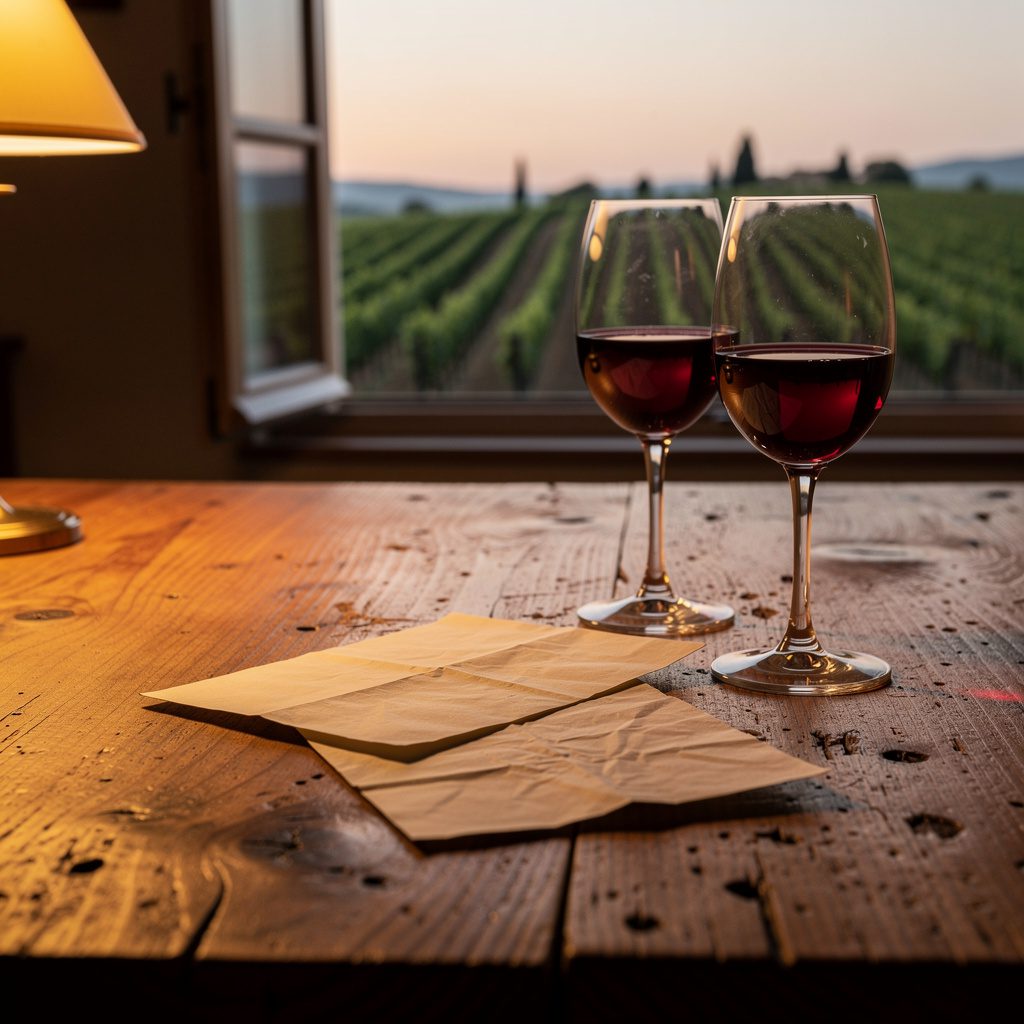
In the kitchen I lit the lamp. He set the pages side by side on the old oak table, mine and his, and neither of us said anything about them at all.
He opened a bottle of last year’s red. He held it the wrong way. I took it from him and showed him, my hands over his, and let them stay there a moment longer than the lesson required.
Outside, the vines stood in their long dark rows, heavy with the last of the season. Through the open window came the smell of warm earth and ripening fruit, and the small, steady sound of a night coming down gently on everything we had both been so careful not to say.
On the table, between the two glasses, the letters lay overlapping at the corners, as if they had finally found each other.

 WhatsApp
 Telegram
 Email




Leave a Reply