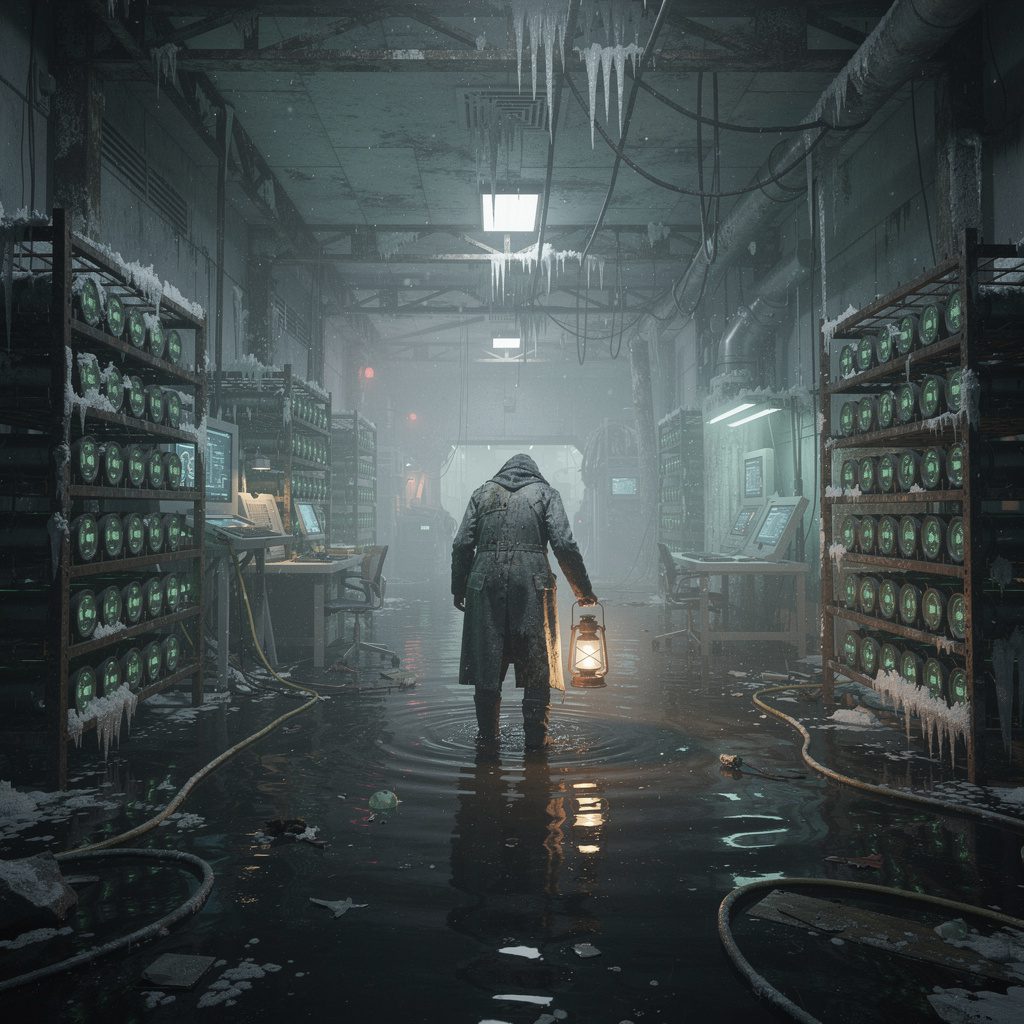
The morning count at Halden Reach began, as it always did, with the sound of the water.
Zofia Zielinski stood on the catwalk above the cistern hall and listened to it drip from the old condensers into the settling tanks, a slow, patient music that had outlasted three governments and one collapse. She was the settlement’s rationing clerk, and her job was numbers: liters per household, grams of protein per child, tablets of iodine per week. She counted them each dawn with a chipped slate and a stub of graphite, because the power cells were for the clinic, not for her. The hall smelled of wet concrete and boiled lichen. Below her, women queued with dented jugs, and a boy chased a rusted bolt across the floor, and nobody looked up at the ceiling where the old city’s ventilation ducts still hung like the ribs of a drowned animal.
That same morning, four hundred kilometers east, in the flooded ruins of a research annex that no map still named, Dr. Eamon Coyle was also counting. He counted stitches.
The annex had been a cold-storage facility once, and its long steel corridors still held a permanent chill, a breath of refrigerant ghosts. Eamon was a field physician, wiry and stooped, with a gray beard he trimmed with a scalpel and hands that had learned to be gentle in a world that rewarded the opposite. He had come here following a rumor, a salvage crew’s story of a sealed chamber. Now he knelt in knee-deep black water beside a steel table bolted to the floor, and on it lay a man.
The man was perhaps forty. He was breathing. His skin carried a faint, waxy sheen, and along his body ran seams: thin, perfectly straight lines of pale tissue, at the neck, the wrists, the hips, the ankles, the sternum. They were not scars. Scars puckered. These were clean as the joins in a well-made coat. Eamon pressed two fingers against the seam at the man’s collarbone and felt no heat of inflammation, no ridge of healing. The flesh on either side simply agreed to be one thing.
“You are not hurt,” Eamon said quietly, to no one.
The man’s eyes opened. They were pale gray, and they moved across the ceiling without recognition.
“Where is the rest of me?” the man whispered.
Eamon sat back in the cold water.
Zofia’s trouble began with a ledger that would not balance.
It was a small thing, and she almost dismissed it. For six weeks the settlement’s water allotment had been one household short. A family of three was drawing rations under a name she did not recognize: Kaspar Wren. No such man lived in Halden Reach. Yet each week, someone collected. She traced the pickups to a shuttered pump house on the north edge of the settlement, a squat brick building the colonists avoided because the generator inside had never been stable, and because a night watchman once swore he heard singing there.
She went at dusk, alone, carrying a pry bar and a lantern she was not supposed to own.
The pump house was larger inside than it looked from the road. The old machinery had been dragged to the walls, and in the center of the floor someone had built a cot, a washbasin, a shelf of salvaged books, a child’s drawing pinned to the brick. It was a home. It was careful and tender and utterly strange. A woman sat on the cot with her back to the door, brushing the hair of a man who did not move.
“I know you,” the woman said without turning. “You are the clerk. Please do not take the water.”
The woman was Morag Fraser, a former pharmacist, and the man was her husband, Kaspar. He had died, she explained, in the great sickness eight years ago. And he had come back.
“Not the way you think,” Morag said. “I found him in the old hospital basement. In pieces, Zofia. Preserved, in cold racks, labeled. Someone had kept the parts of him. I carried him home a little at a time, and I did what the manuals in that basement told me. I put him together.”
Zofia looked at the man on the cot. He was handsome in a faded way, his face slack but whole, his chest rising slowly. She saw the seams on his throat. Fine and straight.
“He breathes,” Morag said. “He eats, a little. But he does not remember me. He does not remember anything. He only asks one question, over and over.”
“What question?”
“He asks where the rest of him is.”
The lantern flame trembled. Somewhere in the walls, the old generator coughed and began, very faintly, to hum.
Eamon had learned the man’s name from a tag sewn into the hem of his gown: a stamped steel rectangle reading R. VANCE, ASSEMBLY 4 OF 9.
Nine.
He spent the first day carrying water, tracing wiring, and reading the dead annex like a patient chart. The facility had not been a hospital. It had been something stranger: a reconstitution lab, built in the last years before the collapse, where the dying had been preserved in segments, sectioned and cooled and catalogued, in the hope that a later age might know how to rejoin them. A memorial and a gamble. The consoles were drowned, but the paper survived in sealed drawers, and Eamon read it by headlamp while Vance slept.
The method was elegant. The body could be rejoined. The tissue would knit, the organs would wake, the heart would remember its rhythm. But memory did not live in tissue alone. It had been stored in a separate medium, a lattice of cultured neural gel in cylinders the size of a thermos, and those cylinders were kept apart from the body for safety.
Assembly 4 of 9. Someone had reassembled Vance and left his memory behind.
Eamon found the cylinder racks on the second night, in a sub-basement flooded to the waist. Rows of them, dozens, each etched with a number. Most had gone dark. Cloudy. Dead. But a handful still glowed a faint, living green.
He heard the footsteps behind him a moment too late.
“Do not touch those.”
The voice was dry and cultured. A woman stood in the doorway holding a lamp and a short iron bar, tall, silver-haired, dressed in a coat of patched wool. Theodora Blackwood. She had lived in the annex for thirty years, she told him, as its keeper, tending the racks with what little power the solar skin on the roof could give.
“You have taken one of my sleepers,” she said. “The man on the table. You have taken him without his memory. Do you understand what you have done?”
“I found him assembled,” Eamon said. “I didn’t do it.”
“Then someone has been here before.”
She swung the bar. He raised his arm. It rang against his forearm and numbed it to the elbow, and then the lamp went over and the water swallowed the light.
Morag would not let Zofia leave. Not out of cruelty; she simply stood in the doorway of the pump house and wept, a quiet shaking that frightened Zofia more than anger would have.
“The settlement council will take him,” Morag said. “They will call him an abomination. They will put him back in the dark.”
Zofia said nothing. She had a clerk’s instinct for what could be written down and what could not, and she knew she should report this. But she looked at the child’s drawing on the brick, a stick figure family under a yellow sun, and she thought about how many names she had struck from the ledger over the years. How many people she had reduced to a line of numbers.
“The manuals,” she said slowly. “The ones you found. Did they say anything about the memory?”
Morag blinked. “There was a cylinder,” she said. “In the basement. I left it. It frightened me.”
“Where?”
“The old hospital. Cold store three. Under the east stairs.”
Zofia was already reaching for her lantern.
The cylinder was where Morag said, cradled in the ruins of a freezer, still faintly green. Zofia carried it back through the night like a sleeping infant, and when she set it on the cot beside the silent man, the gel inside shivered, as though it recognized the shape of him.
A thin cable ran from the cylinder’s base, ending in a socket. Morag had seen it before and had not understood. Now Zofia pressed the end gently against the seam at Kaspar’s nape, and the seam, which had been closed for eight years, parted without a sound.
The man gasped. His eyes opened wide, and the gray in them cleared like fog lifting off a lake.
“Morag,” he said.
Eamon woke in the dark with water in his mouth and a hand on his collar.
It was Vance, standing upright in the flooded corridor, gown dripping, eyes wide and calm. He had walked on his own through the annex to find them.
“I heard it,” Vance said. “A voice. In the wall. Calling a name that is mine.”
Theodora stood a few paces away, the iron bar lowered, her face gone slack with a terrible wonder.
“The racks are speaking,” she whispered. “They have never spoken before.”
Eamon followed Vance’s gaze. At the far end of the sub-basement, one green cylinder pulsed brighter than the rest, a slow rhythm like breathing, and from a speaker grille above it a thin, human voice crackled out of the dark: Reynard. Reynard Vance. Come home.
“My memory,” Vance said. “It has been waiting for me.”
Theodora lowered the bar completely. In thirty years, no one had ever come back for a sleeper. She had kept the racks like a graveyard keeper tends stones, and now one of the stones was speaking.
“Take it,” she said, her voice breaking. “Take him whole.”
Eamon lifted the cylinder from its rack with both hands. It was warm.
Morag stayed by the cot all night. When Kaspar woke again he did not ask where the rest of him was. He asked for water, and for the child, and for the name of the song someone had been humming through the walls. Morag cried and laughed and told him everything, and Zofia slipped out into the cold dawn with her lantern, leaving them alone.
She returned to the cistern hall and took up her slate. At the top of the ledger she crossed out a line that read Kaspar Wren, unknown, and wrote in its place, in steady graphite: Kaspar Fraser, resident, three persons. Water allotment confirmed.
The dripping went on. The queue shuffled. A boy chased a bolt across the floor.
Four hundred kilometers east, Eamon sat beside Reynard Vance on a rusted loading dock in the pale morning, watching a gray sun come up over drowned concrete. Vance held the cylinder in his lap, its cable plugged gently into the seam at his neck, and his face had taken on the quiet focus of a man reading a long-lost letter.
“I remember my daughter’s name,” he said at last. “I remember what she smelled like. I remember dying, and I am not afraid of it.”
Eamon nodded. He had spent a lifetime sewing the living back together and never once asked what, exactly, he was sewing. Now he understood. A body was only the house. The memory was whoever lived in it.
Behind them, Theodora stood in the annex doorway with the other green cylinders cradled in a crate, preparing to carry them out into the world, one by one, to find the bodies that had been waiting.
“There are eight more of him,” she said. “Other assemblies. Other people. They are all out there somewhere, looking for the rest of themselves.”
“Then we will help them look,” Eamon said.
The water lapped quietly at the dock. Far to the west, in a settlement he would never visit, a clerk was writing a name into a ledger, and a woman was telling her husband everything. Neither of them knew the other. Both had done the same quiet, necessary thing: they had refused to leave a person incomplete.
The sun rose. The dripping went on.

 WhatsApp
 Telegram
 Email





Leave a Reply