The bread is still warm when I set it on the table, and that is the first thing I let myself believe is a good sign.
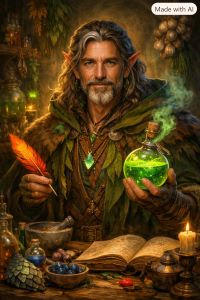
Morning light comes through the shutters of the Hollow Lantern inn in thin gold stripes. Smoke from the hearth. The smell of rye, of crushed rosemary, of the damp wool drying on the pegs by the door. My name is Eryndor Leafbrew, and for thirty years I have made my living from roots, resins and the rare, unmapped berries that only grow where nobody thinks to look. I am not a hunter. I am the man hunters pay when their wounds will not close and their nightmares will not leave.
This morning I am paid to watch four people eat breakfast.
They came out of the Thornwold last night, just after dusk. The village of Marrowgate had been waiting for them for eleven days. Torin Sullivan, the broad-shouldered trapper who leads the party. Jia Deng, the cartographer, who sketches even while she chews. Long Sun, the quiet one, a lantern-bearer with burn scars up both forearms. And Viggo Ronningen, young, loud, the sort who laughs a little too early at his own jokes.
Four of them. They went in with five.
I count them again. I always count again.
“Eat, Eryndor,” Torin says, pushing the bread toward me. “You look like you slept in a ditch.”
“I did not sleep.”
“Then you look like you wished you had.” He smiles. It is a good smile. It sits on his face the way a coat sits on a stranger.
I take a piece of bread. I do not taste it.
The village elders hired me three days ago, when the first traveler came out of the forest. A peddler named Haldane, a man the whole of Marrowgate had known for twenty years. He walked out of the trees with his cart and his mule and his hat, and he was Haldane in every way that a person could check. Same voice. Same limp. Same stories about the same bad winter.
His wife noticed it first. Not a wrong word. Not a wrong face. He simply no longer cast his old habit of humming when he was nervous. And when she asked him about it, he looked at her with such polite, patient confusion that she packed a bag and left for her sister’s that night.
The elders call it the Returning. They say the Thornwold gives back what it takes. They do not say what it keeps.
I am here to find out.
“Where is Isak?” I ask.
The table goes still.
It is a small stillness, the kind you could miss. Jia’s pencil pauses. Long Sun lifts his eyes from his bowl. Viggo stops mid-laugh, and that is the strange part, because he stops exactly where a laugh would end, with no trailing breath.
“Isak Sandvik,” Torin says slowly. “The fifth in your party. The tall one with the crooked nose.” He turns his cup a quarter turn on the table. “He did not make it. A fall at the ravine. We told the elders.”
“You told them he fell.”
“He fell.”
That is the second thing I let myself believe. Grief explains a great deal. Grief explains the flatness, the careful speech, the way they all look at one another before they answer. If I were in their place I might look the same.
I tell myself that. I tell myself that until Jia turns her sketchbook around to show me the ravine, and the drawing is perfect.
Perfect in the wrong way. Every fern, every stone, every ripple in the stream. But Jia is a woman who has drawn maps for twenty years, and she draws the way all mapmakers draw: with small errors, small shortcuts, her own tremor in the line. This is not drawn. This is copied. It is a ravine remembered by something that has never had to forget.
My hands are cold. I fold them in my lap.
“Long Sun,” I say, “the scars on your arms. How did you get them?”
He looks down at them as if they belong to someone else. “The lantern oil caught,” he says. “In the forest. Two nights ago.”
I have known Long Sun for six years. The scars are older than two nights. They are older than six years. He told me once, over a bad barley wine, that he got them pulling his brother from a burning mill. He told me that story and then did not speak for an hour.
He does not remember telling it.
Or he never knew it. I do not yet know which is worse.
“I think,” I say carefully, “that I should walk the forest edge today. Alone. I need to gather samples.”
“No,” says Torin.
It comes out too fast. They all hear it. Viggo’s mouth twitches toward a smile that does not arrive.
“I mean,” Torin amends, “we should come with you. You are the only one who knows what you are looking at. It is not safe.”
Safe. The word lands in the room like a coin on a stone floor.
I nod. I stand. I smile my most harmless apothecary’s smile, the one I wear for frightened patients and tax collectors.
And I understand, with a certainty that sinks cold through my whole body, that I am no longer a man watching suspects at breakfast.
I am a man who is being watched by them.
We walk to the forest in single file. Torin first. Viggo and Jia in the middle. Long Sun behind me, his footsteps so quiet I keep turning to check he is there.
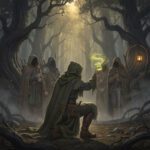
The Thornwold waits at the end of the meadow like a held breath. Black trunks, close as the bars of a cage. The canopy so thick the morning stops at its edge. I have crossed a hundred forests. I know the scent of loam, of fungus, of the sweet rot of fallen fruit. This one smells of nothing. Not of earth. Not of leaf. Of an empty room where someone has just been standing.
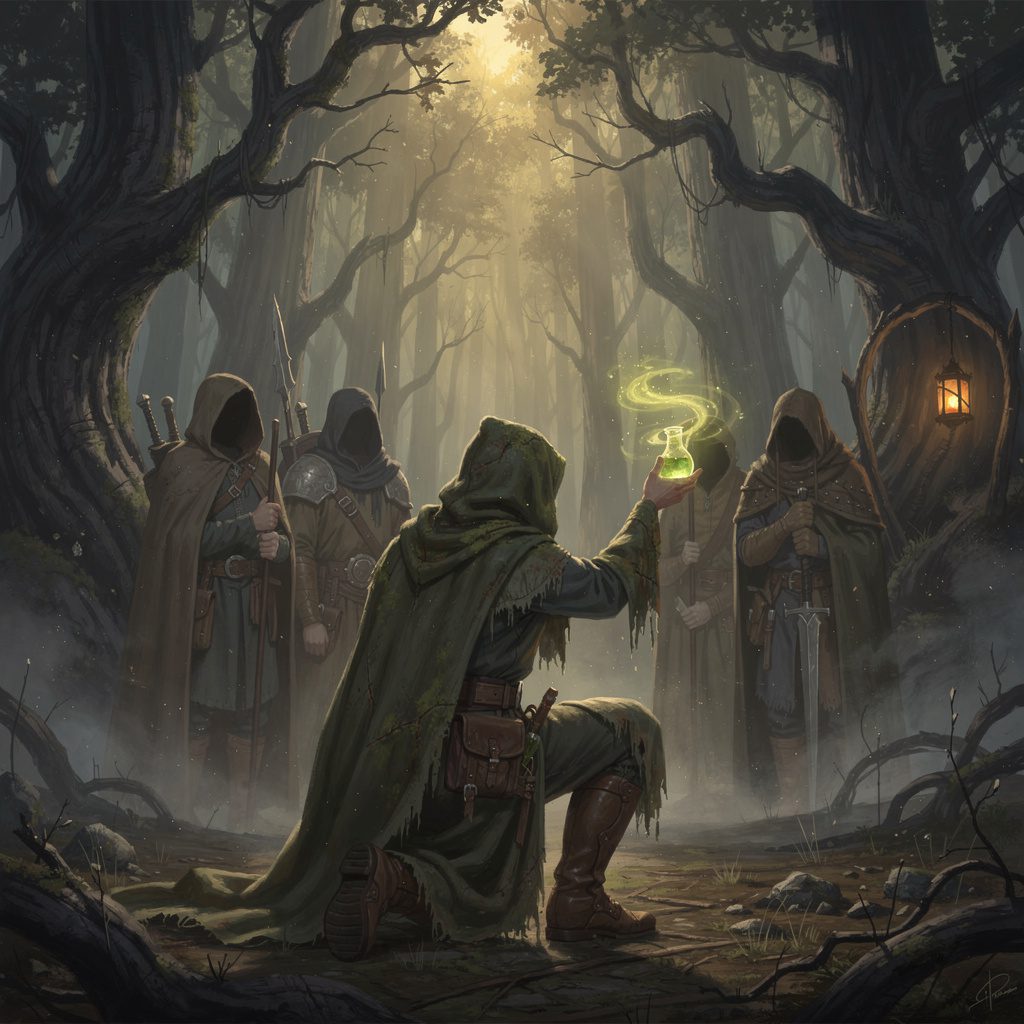
At the tree line, I kneel and take a small vial from my satchel.
“What is that?” Jia asks.
“Moonroot tincture. It clouds in the presence of certain spores.”
A lie. Half of one. It is moonroot, yes, but it does not cloud for spores. It clouds for one thing only: the breath of something that is pretending to breathe.
I hold it up toward Torin first, as if checking the light.
The liquid stays clear.
Relief goes through me so sharply I nearly laugh. Then I turn it toward Viggo, and it stays clear. Toward Jia. Clear. Toward Long Sun, who has come to stand very close behind me.
Clear.
“Well,” I say, and my voice sounds distant, “that settles that.”
It does not settle anything. It means my test is wrong, or the thing in front of me is better than my test. Either way I am standing at the edge of the Thornwold with four people who look like my friends and one chance to be right.
“Eryndor,” Torin says gently. “You are afraid of us.”
“I am afraid of everything. It is how I have lived this long.”
“We are tired. We are grieving. That is all.” He steps closer. His boots make no sound on the dry grass. “You think we are something else.”
“I think,” I say, and I make myself meet his eyes, “that there were five of you.”
“Isak fell.”
“Then tell me what Isak said before he fell.”
Silence. Not an angry one. A searching one. Four faces turn inward, reaching, the way a person pats their pockets for a key.
Viggo is the first to speak. “He said…” He frowns. “He said the trees were too quiet.”
“He said,” Jia says, “that his knee hurt.”
“He did not speak at all,” says Long Sun.
Three answers. Three certainties. All of them delivered with the same open, honest, wounded confidence.
Torin looks at them, and for the first time something crosses his face that is not borrowed. A flicker of real, naked uncertainty. Not a mimic’s calculation. A man’s fear.
And I realize I have been asking the wrong question.
I did not need to find out whether they were copies.
I needed to find out whether they knew.
The forest answers before any of us can speak. A sound rolls out of the trees, low and long, like a door opening somewhere very deep. The air gives a slow, patient exhale across my face. It is warm. It smells, finally, of something: bread. Rye. Rosemary. Wool drying by a fire.
It smells of the morning I thought was real.
“Oh,” says Jia softly. Her pencil drops from her fingers. “We never left, did we?”
No one answers. Long Sun looks down at his scarred arms. Viggo’s laugh finally comes, a thin, broken fragment of it, and he presses a hand to his mouth.
“The inn,” Torin whispers. “The bread. I remember the bread. I do not remember eating it.”
I look back across the meadow. Marrowgate is still there, smoke rising, shutters bright. But the smoke does not drift. It hangs in the air in a perfect, motionless line, like a thing painted on glass.
I have been inside the Thornwold since the moment I stepped through its edge. Perhaps since the moment I accepted the elders’ coin. The forest does not simply return its travelers changed. It builds the world around them to match, a village, a morning, a table laid with warm bread, and it hands them back to whoever is waiting. Even me.
The thing that lives in these trees is not hunting us. It is keeping house.
Five went in. Four came back. Somewhere in the dark between the trunks, a fifth is still walking, the only one who never agreed to be copied.
“Isak,” I say.
The four of them turn toward me, and all at once I see what I could not see before. Not strangers. Not monsters. Four frightened people who have been made soft at the edges, whose memories have been sanded smooth, who are trying with everything they have to be who they were.
Torin is crying without sound. “I do not know if I am real,” he says.
“You are real enough to be afraid,” I tell him. “The forest can copy a face. It cannot copy that.”
I open my satchel and take out the thing I have carried since Marrowgate, the one ingredient I did not name to anyone: a single dried bloom of ashwort, grown on a grave where nothing else would, bitter and bright. A flower that remembers. Crushed in flame, it releases the truth of whatever stands nearest.
I strike a spark. The bloom catches. Pale smoke curls upward, and the false morning begins to peel.
The meadow thins like wet paper. The village shivers and falls away, and beneath it is only more forest, black and endless and patient. The warm smell of bread curdles into the cold smell of old earth. Somewhere ahead, at the end of a path that was not there a moment ago, a lantern burns.
Isak Sandvik stands beneath it, tall, crooked-nosed, gray with exhaustion. He has been holding the light for eleven days.
“You took your time,” he says, and his voice cracks.
Torin reaches him first. Long Sun is a half step behind. Jia is still carrying her ruined sketchbook; Viggo is laughing and crying at once. They do not stop to ask whether they are copies or originals. They simply stumble into the light, all five of them, and the lantern holds.
The forest lets us go. Not gracefully. Not without a long, grudging sigh through the branches, like a house giving up on guests it wanted to keep.
We walk out into a real morning. Cold wind. Thin rain. A smell of wet grass and woodsmoke that drifts the way smoke should.
At the tree line, I check my vial one last time. Held toward each of them, it clouds, faintly, faithfully, the exact gray-gold of a living breath.
Five went in. Five come out.
And for the first time in thirty years, I eat bread I am certain I will taste.

 WhatsApp
 Telegram
 Email


Leave a Reply