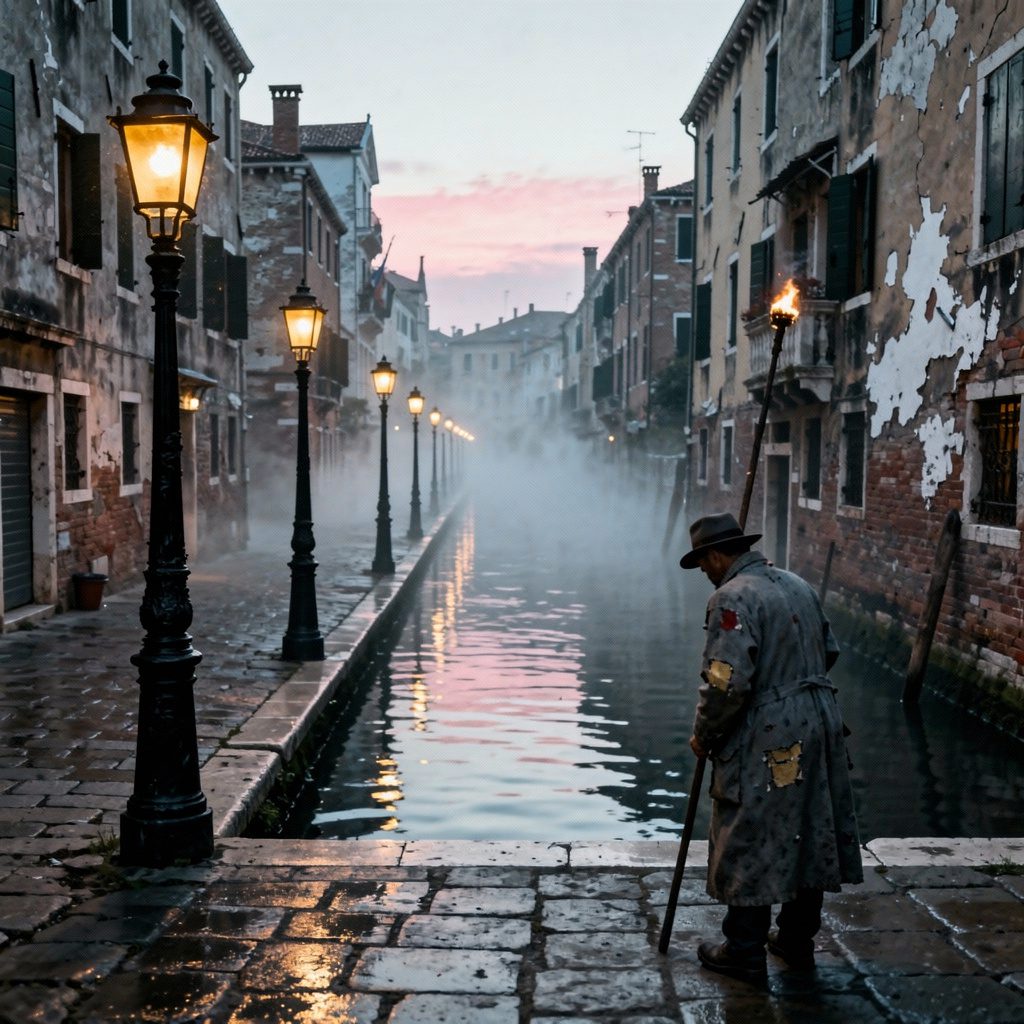
At ten past four every morning, Wojciech Dabrowski walked the length of Tallow Row and checked the lamps.
There were sixty-one of them, set into black iron posts along the old canal. Each one held a small, steady flame that needed no oil and no wick. The city of Karrowmere had burned them for three hundred years. Children were told they were lit by the breath of the first mayors, and children believed it, the way children believe anything that has never once gone wrong.
Wojciech wore a lamplighter’s grey coat, patched at the elbows, and carried a brass key he never needed to use. He only touched each post with two fingers, the way a doctor touches a wrist. Sixty-one posts. Sixty-one small warm pulses under the cold iron. It was the whole of his job, and the whole of his pride.
On the morning this story begins, the thirty-eighth lamp was cool.
He stood in front of it for a long moment. The flame was there, yellow and upright, but it gave off no heat at all, like a painted flame on a plate. He pressed his fingers harder against the post. Nothing. Behind him, the canal slid by, black and unhurried, smelling of wet stone and bread from the Kone bakery two streets over.
He told himself it was the weather. He told himself that all the way to the fortieth lamp, which was cool as well.
The Guild of Wards kept its offices above a cobbler’s shop, because the Guild had long ago decided that magic should look as boring as possible. By midmorning, Wojciech was standing in the narrow stairwell with his cap in his hands, and Elzbieta Tkachenko was reading his report with her lips pressed into a flat line.
She was the senior warden of the eastern district, a broad woman in her fifties with ink-stained cuffs and a habit of tapping her thumb against her sternum when she was thinking. She tapped it now.
“Two lamps,” she said.
“Two that I found, Warden. I have not walked the western canal.”
“Don’t.” She folded the report in half. “Go home. Tell no one. I’ll send someone.”
She said it too quickly, and Wojciech had spent forty years noticing small things. He noticed that the Guild’s front office, usually loud with clerks, was nearly empty. He noticed that the speaking-bell on the wall, the one that rang whenever the city’s great wards shifted, had been wrapped in a wool scarf. Someone had muffled it.
He went home. He did not tell anyone. But on the way, he passed the Kone bakery, and Elijah Kone was standing out front with flour to his elbows and a look on his face like a man trying to remember a word.
“My ovens,” Elijah said, before Wojciech could greet him. “The fire-stones. They have always held heat for a full day on a single lighting. Today they went cold by noon.” He rubbed his jaw and left a pale streak of flour. “My father’s father said they would outlast the city.”
“Maybe a bad batch of stone,” Wojciech offered.
“They are not batches. They are the same six stones. They have always been the same six stones.”
Neither of them said what they were both thinking. In Karrowmere, you did not say such things out loud. Saying them was how you made them true.
By the end of that week, the whole city was pretending very hard.
The market bells rang a half-beat late, and everyone agreed not to notice. The water that rose through the old pipes each morning, warm and faintly sweet, now arrived lukewarm and tasting of iron. The gulls that had nested on the Guild roof for generations simply left one evening, all at once, a grey cloud lifting off into the dusk. Kaito Tang, who sold paper charms from a cart near the river steps, found that none of his charms would hold a spark anymore. He sold them anyway, at half price, and told customers they were decorative.
And under all of it, a quiet kept spreading. The city had always hummed. No one had ever heard the hum, only felt it, the way you feel a floor beneath you. Now, in the hour before dawn, Wojciech swore he could feel the floor thinning.
On the ninth night, a girl came to his door.
She was perhaps nineteen, wrapped in a travelling cloak the colour of old ash, with a leather case strapped across her back. Her face was pale and narrow, and her eyes had the stillness of someone who had spent a long time listening to things other people could not hear. Jing Sato, she said her name was. A student of the Ossuarian Sanctum, three weeks out from the northern roads.
“The Sanctum sent me,” she said. “The dead in the north have gone restless. They say something is draining the old magic from the south, and that it is coming from here.”
Wojciech looked at her for a long time. Then he stepped aside and let her in.
He made tea. She did not drink hers. She sat with both hands flat on his kitchen table and her head slightly tilted, as though listening to a conversation in another room.
“You feel it too,” she said. “The thinning.”
“Everyone does. No one will say.”
“I know. That is the first thing I noticed on the road in. Eleven thousand people, all of them holding the same breath.” She turned her cup a quarter turn on its saucer. “I need to speak to your wardens. The real ones, the ones who know why this is happening.”
“They do not know.”
Jing Sato’s eyes lifted to his. They were very dark and very calm.
“They know,” she said. “Somebody always knows.”
The Guild of Wards had a cellar. This was not a secret exactly, but it was not a thing discussed, and it took Jing Sato three days of quiet inquiry and one careful bribe of Kaito Tang’s to learn where the door was. It sat behind a wall of shelved ledgers in the back of the cobbler’s shop, a plain oak door with no handle on the outside.
Elzbieta Tkachenko was waiting beside it when they arrived, as though she had expected them. She held a small lantern. Its flame was steady and entirely without warmth.
“I told you to go home,” she said to Wojciech, without anger.
“You did.”
“And you brought a stranger.” She looked at Jing Sato, at the leather case, at the grey cloak. Her thumb tapped her sternum. “Necromancer’s apprentice. Of course. The Sanctum always sniffs these things out first.”
“You are not surprised,” Jing Sato said.
“I am tired,” Elzbieta said. “That is different.” She pressed her palm to the wood. The door swung inward on silent hinges, and a smell came up from below, old stone, cold earth, and something faintly sweet underneath, like flowers left too long in water.
They descended.
The stairs went down further than any cellar should. The walls changed as they went, plaster giving way to rough-cut stone, and then to something older, smooth and dark and slightly damp to the touch. Lamps burned in iron brackets, the same cold flames as the ones on Tallow Row. Wojciech counted sixty-one of them before the stairs ended. He stopped counting after that, because the number meant something he did not want to think about yet.
At the bottom lay a round chamber, wide as a market square, its ceiling lost in shadow. In the centre stood a stone basin set into the floor, perhaps ten paces across. It was dry. It had clearly once been full. Around its rim, worn deep into the stone, ran a groove, and in the groove sat a thousand small objects: buttons, thimbles, rings, a child’s tooth, a lock of hair tied with thread, a tiny wooden horse. Offerings. Pieces of people.
Elijah Kone was already there.
He sat on the lowest step with his flour-white hands hanging between his knees, and he looked up at them without surprise. Beside him stood Ade Asante, the Guild’s youngest warden, a thin man in a too-large coat who was visibly shaking.
“They called me down last night,” Elijah said quietly. “They said the city needed a baker’s testimony. I did not understand what that meant. I do now.”
Jing Sato walked slowly to the edge of the basin and knelt. She laid her fingertips against the stone, and the cold flames along the walls leaned toward her all at once, the way grass leans in wind.
“This is not a ward,” she said softly. “This is a grave.”
No one answered.
“Something is buried under this city,” she went on. “Something very large, and very old, and it is not asleep. It is being held. Your wards, your lamps, your warm water, they are not gifts. They are the leakage from a cage.” She lifted her head. “For three hundred years, the people of Karrowmere have been living on the heat of a thing that is slowly dying beneath them.”
Ade Asante made a small sound, half a sob.
“The city’s founders made a bargain,” Elzbieta said. She had not moved from the foot of the stairs. Her voice was flat and exhausted and very steady. “They bound a power to this ground, a great spirit, an old god, whatever you want to call it. In exchange for its strength, they promised it company. Every hundred years, a willing soul goes into the basin. A volunteer. A keeper. The spirit holds the city’s magic, and the keeper holds the spirit.”
“And the last keeper?” Jing Sato asked.
Elzbieta’s thumb stopped tapping.
“Died eleven months ago,” she said. “We have been unable to find a replacement.”
The silence in the chamber was enormous. The flames on the walls had gone very still, and every one of them was turned toward the basin.
Wojciech felt something move in his chest, slow and heavy. Forty years of lamps. Forty years of touching cold iron and feeling the warmth of a pulse beneath it, and believing the pulse was the city’s gift to him. It had been something else’s breath.
“Why not tell us?” he said. His voice came out smaller than he wanted. “Why not ask? There are eleven thousand people in this city. You would have found a volunteer.”
“We asked,” Elzbieta said. “For the first three months. The ones who came forward, the spirit refused. It wants someone specific. It wants someone who understands what it is. And there are only two kinds of people who can hear it clearly enough to bargain.”
“The dying,” Jing Sato said, “and the necromancers.”
Elzbieta met her eyes. “Yes.”
The girl in the grey cloak rose slowly to her feet. She looked at the basin, at the thousand small offerings in the groove, at Ade Asante shaking, at Elijah with his flour-white hands, at Wojciech Dabrowski and his two cold fingers. Then she looked at Elzbieta Tkachenko again.
“You were hoping I would come,” she said.
“I sent word to the Sanctum six months ago.”
“And you let them believe it was a rumour. You let me walk into this city thinking I was investigating.”
“I let you walk into this city thinking you had a choice.” Elzbieta’s voice cracked, just once, and then steadied. “I am sorry. I mean that. But the thinning will reach the lamps, and then the water, and then the stones under our feet. A city does not survive losing its heart. Eleven thousand people, Jing Sato. Children. Bakers. Lamplighters.”
Jing Sato was quiet for a long time. Then she walked to the edge of the basin and stepped over the groove, down into the dry stone bowl, and stood in the centre of it with her hands open at her sides.
“I will speak to it,” she said. “That is all I promise. I will speak to it and I will listen.”
She closed her eyes.
The cold flames on the walls flared white, then guttered, then went out, all sixty-one at once. For a long breath the chamber was entirely dark. Wojciech heard Ade Asante whimper. He heard Elijah’s breathing, heavy and uneven. He heard the stone itself, deep and slow, like a vast animal turning over in its sleep.
Then a voice spoke, and it was not Jing Sato’s.
It came from the basin, from the air above it, from the walls. It was neither male nor female, neither young nor old. It sounded like wind in an empty house, like water dripping in a cistern, like something very large trying to speak very gently so as not to frighten them.
“*Three hundred years,*” it said. “*And at last, one who will not lie to me.*”
Jing Sato’s lips moved, but the words that came out were still not hers.
“*They told you I was caged. They told you I was dying. Ask them who built the cage. Ask them who wrote the bargain. Ask the warden why the last keeper did not die of age.*”
The lamp in Elzbieta’s hand went out. In the darkness, Wojciech heard her take one small, shuddering breath.
A single flame woke in the centre of the basin, pale gold, hovering above Jing Sato’s open palms. By its light, they all saw her face. Her eyes were open now, and they were not dark any longer. They were the colour of old amber, and they were looking directly at Elzbieta Tkachenko.
“*The keeper was not chosen,*” the voice said. “*The keeper was ended. By your hand. Eleven months ago, when I asked to be released, you were afraid, and you could not bear to lose the warmth.*”
“No,” Elzbieta whispered.
“*You have known for eleven months that I wanted to leave. You have known that the thinning was not my failing but my leaving. I am not dying. I am departing, a little more each day, because no one would let me go. And you have lied to your own city so that you would not have to feel the cold.*”
The amber light pulsed once, softly, like a heartbeat.
Wojciech looked at Elzbieta. The senior warden had slid down the wall until she was sitting on the bottom stair, her ink-stained hands over her mouth. Her thumb was not tapping now. It lay still against her lips, trembling.
“I thought,” she said, through her fingers. “I thought if we found another keeper, I could undo it. I could make it right. I thought if I could just hold on long enough.”
“*You thought a god could be a lamp,*” the voice said, with something almost like pity.
Jing Sato’s head turned, slow as a sleepwalker’s, until the amber eyes found Wojciech Dabrowski.
“*You. The one who touches the posts.*”
He swallowed. “Yes.”
“*Forty years, you have greeted me each morning. Two fingers against iron. A small, kind pressure. No one else ever did.*” The gold flame in the girl’s palms warmed, just slightly. “*I would like to say something to you, and I would like you to carry it for me.*”
Wojciech’s mouth was dry. “What?”
“*Thank you.*”
The amber light rose from Jing Sato’s hands in a slow spiral, brightening as it climbed, filling the vast round chamber with a soft glow like early sunrise. The thousand small offerings in the groove began to shimmer, buttons and rings and baby teeth, and one by one they dissolved into tiny motes of gold and drifted upward. The walls exhaled. The floor sighed. Somewhere far above, on Tallow Row, sixty-one lamps flickered once, together, and burned brighter than they ever had.
Then the light folded in on itself, gently, and went out.
Jing Sato swayed. Wojciech was across the groove before he knew he had moved, catching her under the arms as she folded. She was breathing, slowly, and her eyes, when they fluttered open, were dark again. Ordinary. Human.
“It’s gone,” she said faintly. “It left. It said to tell you it was grateful.”
The chamber was dark and cold and smelled only of old stone. No more sweetness. Elijah Kone lit a match with an unsteady hand. The little flame was warm, an ordinary warm, a flame that would burn out if no one fed it.
“The lamps,” Ade Asante whispered. “The wards. The city—”
“Will be ordinary,” Jing Sato said. “Not dead. Ordinary. You will have to light your own fires now.” She tried a smile and almost managed it. “I think it is a fair trade.”
They climbed the stairs in silence, Elzbieta last, walking like a woman twenty years older. At the top, in the empty Guild office, the speaking-bell on the wall stirred under its wool scarf. Ade reached out and unwrapped it. It rang once, clear and sweet, and nothing happened. No great ward shifted. No old power answered.
They stood and listened to the ordinary silence.
Wojciech walked home through the grey dawn. Tallow Row lay quiet along the canal. He paused at the first post, laid two fingers against the cold iron, and felt, beneath it, nothing at all.
He stood there a long while.
Then, because it was ten past four, and because it was his job, and because a thing deserves a greeting even when it can no longer answer, he said very softly, “Good morning.”
The flame in the lamp burned on, small and yellow and warm. Not magic. Only fire. It was enough.

 WhatsApp
 Telegram
 Email






Leave a Reply